Augusta Gold IRA Direct vs Indirect Rollover
TL;DR: An Augusta gold IRA rollover runs one of two ways: a direct rollover, where the money moves institution to institution and you never touch it, or an indirect rollover, where you receive the funds and have 60 days to redeposit them. The risk sits almost entirely on the indirect side. This guide compares both head to head and frames which to pick.
| Rollover Path | One-Line Definition |
| **Direct rollover** | The money moves institution to institution and the saver never holds it |
| **Indirect rollover** | The saver receives the distribution and has 60 days to redeposit it |
| **Direct, IRA-to-IRA** | A trustee-to-trustee transfer, not a rollover, no once-per-year cap |
| **Indirect risk set** | A 60-day clock, 20% employer-plan withholding, a once-per-year cap |
| **Structural default** | The direct path, because it removes every failure point at once |
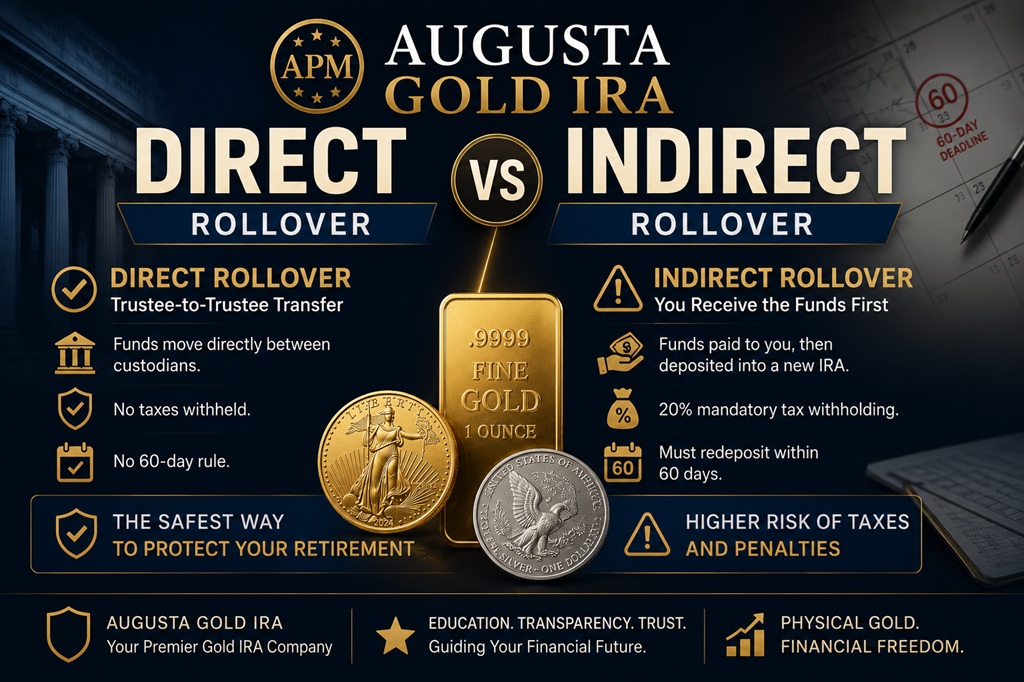
What Is the Difference Between a Direct and Indirect Rollover?
A direct rollover sends retirement savings straight from one institution to the next, and the saver never personally receives a cent. An indirect rollover routes the payout to the saver first, who then has 60 days to put the full sum back into a receiving IRA. The structural split is a single question: who is holding the cash partway through.
That one question shapes everything below. The first option keeps the savings entirely off the saver’s books, so two institutions settle it privately. The second deposits the payout with the saver and trips a countdown. For an IRA-to-IRA case, the first option is a trustee-to-trustee transfer, which is not a rollover at all and steps around the once-per-year ceiling the indirect kind runs into. That one fact anchors the entire head-to-head.
The rules here are not a special gold rulebook. A gold IRA uses the same Traditional or Roth tax wrapper as any IRA, so a balance already sitting in a workplace plan or another IRA can generally move into the self-directed structure. Why state the wrapper point at all? Because it means the direct-versus-indirect call is the same one a saver faces moving any retirement balance, with identical stakes.
Read this page as a buyer’s verdict, not a procedure manual. It weighs one route against the other and lands on a recommendation. It does not derive the tax math, walk the paperwork, or list every eligible source account. Each gets its own page, linked at the point it matters rather than repeated here.
Which route fits a given saver turns on that saver’s own retirement and tax picture. Run the choice past a qualified tax or financial adviser before any money moves.
What Are the Pros and Cons of a Direct Rollover?
A direct rollover’s structural advantage is blunt: the money never lands in the saver’s hands. There is no 60-day clock to miss, no withholding to front and recover, and an IRA-to-IRA direct move is not subject to the once-per-year limit. The only practical con is that the move depends on two institutions coordinating.
Read the upside as a list of risks that simply are not present. Nothing is distributed, so no 60-day deadline exists. No balance sits in the saver’s own account mid-move. No withholding has to be fronted and clawed back later. And an IRA-to-IRA version, a trustee-to-trustee transfer, escapes the once-per-year limit entirely. Four advantages, each one a hazard the slower route absorbs that this one wipes out.
A like-for-like point rounds out the upside. Traditional stays Traditional and Roth stays Roth on arrival, because the move continues an existing structure rather than opening a fresh contribution. The saver has no reclassification decision to get right. That is one less thing that can go sideways.
So what is the downside? Exactly one, and it is mild. The move needs two institutions to coordinate, so its pace is set by whichever is slower, and that timing is out of the saver’s hands. No penalty attaches to a slow direct move and no clock expires. The cost is patience, not exposure. Weighed against four clean advantages, a single self-resolving wait is why this column reads almost empty, and that imbalance is the whole reason the weigh-up is worth running.
Picture the lopsidedness with a plain illustration. A saver rolling a sizeable balance who picks the direct route signs one authorization, then waits while two institutions settle it, and the worst realistic outcome is that the wait runs a little long. The same saver picking the slower route is suddenly the one tracking a hard sixty-day count, sourcing a withholding shortfall from a separate account, and watching an annual frequency limit that a single prior move could already have spent. One picture is a calendar reminder. The other is a stack of obligations any one of which, missed, converts a retirement balance into a taxed event. The two pictures are not close, and the worked contrast is exactly why the direct column wins before a single number is run.
The step-by-step direct-transfer procedure and which partnered custodian runs it belong to the trustee-to-trustee transfer guide. This section weighs only the trade.
The transfer and rollover rules behind a self-directed precious-metals IRA shift with new IRS guidance, and the picture here reflects the publication date. Verify the current rules with an IRS-approved trustee or a qualified tax adviser before acting.
What Are the Pros and Cons of an Indirect Rollover?
An indirect rollover’s only real structural advantage is short-term access to the funds for up to 60 days. The cons stack heavily against it: a strict 60-day deadline, a mandatory 20 percent withholding on employer-plan distributions, and a once-per-year cap on IRA-to-IRA indirect rollovers.
Begin with the lone upside, stated plainly rather than buried. The saver holds the proceeds personally for up to 60 days before they have to land back inside a receiving account. That temporary use is the single plus on this side of the ledger. Take it off the table and nothing is left that the safer route does not supply without the attached strings.
Drawback one is the deadline. Sixty calendar days, no grace for weekends, holidays, or processing lag, and a slipped window turns the entire amount into a taxed payout. What that costs a saver in dollars belongs to the tax-benefits page. On this ledger it is the single heaviest line: a fixed date resting on the saver alone.
Drawback two is the holdback shortfall. A 401(k)-style indirect payout arrives already 20 percent lighter, yet the whole pre-holdback figure still has to be redeposited to keep the position sheltered, so the saver supplies that 20 percent from separate savings until it is recovered. On this ledger it is a self-funding obligation bolted to an already-strict date.
Drawback three is the frequency lock. Just one indirect IRA-to-IRA move is allowed in any rolling twelve months across every IRA a person owns, and the slot does not reopen early.
“An individual receiving an IRA distribution on or after January 1, 2015, cannot roll over any portion of the distribution into an IRA if the individual has received a distribution from any IRA in the preceding 1-year period,” noted Internal Revenue Service Announcement 2014-15.
The safer route has no comparable ceiling. Three drawbacks against one upside is the entire shape of this side, and the 60-day window has its own 60-day rollover rule page.
Whether the slower route ever beats the safer one is a saver-specific call. Walk it through with your own qualified tax or financial adviser before taking any payout. The governing IRS rules are intricate and shift with new legislation.
How Big Is the Risk Gap Between the Two Paths?
The risk is asymmetric, not a matter of degree. A direct rollover has effectively no failure point the saver controls. An indirect rollover stacks three: a missed 60-day deadline, an under-funded redeposit caused by withholding, and a blown once-per-year cap. The gap between the two is structural.
Set the failure points side by side and the asymmetry is obvious. The direct path has zero saver-controlled failure points, because the saver never holds the money and there is no deadline to meet. The indirect path has three independent ones, and each can convert the move into a taxable distribution on its own. This is not one path being slightly safer. It is one path with nothing for the saver to get wrong against another with three separate ways to get it wrong.
The three weak points on the slower route are not mutually exclusive, which is the part savers underestimate. An employer-plan indirect move can trip the withholding shortfall and the calendar limit together, since the held-back fifth and the full redeposit both fall under one deadline. They stack rather than queue politely. The faster route erases all three in a single stroke, because nothing the saver never touches can fail in the saver’s hands. Which is the safer bet for a five-figure retirement balance? The arithmetic answers itself.
Quantify it a different way. On the faster route the count of things the saver can personally botch is zero. On the slower one it is three, any single one of which is enough to undo everything. Zero versus three-any-of-which-is-fatal is not a close reading. It is the sharpest gap in the whole decision, which is why this contest resolves so one-sidedly.
Is the slower route a trap, then? Not quite. It demands flawless execution to reach the spot the faster route reaches on autopilot. A method that only works if nothing goes wrong is strictly worse than a method with nothing to go wrong, when both deliver the same balance to the same place. That is the gap stated as plainly as it goes.
A rollover decision turns on facts specific to one saver. Put the question to your own qualified tax or financial adviser before acting, and read any pressure to settle it on a first call as the warning it is. Investing involves risk, including the possible loss of principal.
When Should You Use a Direct vs an Indirect Rollover?
In almost every case the safer route wins. Pick it whenever the money already sits in a retirement account, and keep the slower route in reserve only when a specific, named situation forces a saver onto it.
The grid pairs four common situations with the answer for each and the one-sentence reason. It is the practical heart of this head-to-head.
| Situation | Pick | One-Sentence Reason |
| **An existing IRA moving to the Augusta self-directed IRA** | Direct (trustee-to-trustee transfer) | No 60-day clock, no once-per-year ceiling |
| **A former-employer 401(k), 403(b), 457(b), or TSP** | Direct rollover | Skips the mandatory 20% withholding and the clock |
| **A saver who genuinely needs the cash for a few weeks** | Indirect, eyes open | The 60-day window is all it buys |
| **Already used one indirect IRA-to-IRA move this year** | Direct only | The slower door is shut until the year turns |
Two edge situations trip savers up and deserve a plain read. The first is a partial move. Shifting only part of a balance changes nothing about which route is safer, and a partial indirect IRA-to-IRA move still burns the annual slot exactly as a whole one would. Splitting the sum does not split the danger away. The second is whether the money starts in an employer plan or an IRA. The annual ceiling restricts IRA-to-IRA indirect moves, not an employer-plan payout, but the employer-plan version brings the mandatory 20 percent holdback instead. The starting point swaps which drawback bites, never which route is safer. Either way the answer holds.
Reduce it to one sentence. Choose the route where the cash never touches the saver, since that lone trait neutralizes every weak point together. Step onto the slower route only when a named situation, like a real short-term need for the cash, forces it, and go in accepting the deadline and the holdback as the toll. When both can carry the same balance, the one with nothing to fumble wins.
Whichever route the situation points to is executed by the separate IRS-approved trustee, with Augusta only the metals dealer. The full account-opening sequence belongs to the Augusta Precious Metals application process guide. This page stops at the answer.
The right route depends on one saver’s own facts. Check with your own qualified tax or financial adviser before locking it in.
Can You Switch From an Indirect to a Direct Rollover Midway?
Not really, and that one-way quality is the decision point most savers miss. Once a distribution has been taken, the indirect route is already underway and its clock is already running. There is no button to undo the payout and convert it retroactively into a clean institution-to-institution transfer. The choice is made the moment money leaves.
That irreversibility cuts one direction only, which is the gap restated as timing. A saver who plans the institution-to-institution route and changes nothing simply lets it complete. A saver who starts the slower route is stuck redepositing the full sum inside the 60-day window like anyone else on it. Picking the safer route preserves every option. Picking the riskier one forecloses the safe exit.
A second one-way door compounds the first. Spend the single annual indirect IRA-to-IRA slot and it is gone for twelve months, with no way to reclaim it early. So the slower route can lock a saver out of itself as well, while the direct route imposes no such forfeiture. This is why the recommendation lands before any money moves rather than during. A choice that cannot be walked back is a choice worth making slowly. Why would a careful saver start down the one route that removes its own off-ramp without a clear reason to?
Augusta’s onboarding posture supports deciding it early rather than under deadline pressure. The saver chooses the IRS-approved trustee, and the structural transparency is the published stance.
“You’ll always have full transparency and the freedom to choose the best fit for your gold IRA,” noted Augusta Precious Metals on its gold IRA page.
Always consult your own legal, financial, and tax professionals before opening or funding a gold IRA.
Frequently Asked Questions
What is the difference between a direct and indirect Augusta rollover?
A direct rollover moves the money institution to institution and the saver never touches it. An indirect rollover sends the distribution to the saver, who then has 60 days to redeposit the full amount into the receiving IRA. For an IRA-to-IRA move, the direct path is a trustee-to-trustee transfer, which is not a rollover and is not subject to the once-per-year limit. The structural difference is who holds the money in between.
Is an Augusta direct rollover better than an indirect one?
For almost every saver, yes. The direct path has no 60-day clock, no withholding to front, and no once-per-year cap on IRA-to-IRA moves, while the indirect path stacks all three. The only structural advantage of the indirect path is short-term use of the funds for up to 60 days. The detailed tax consequences are covered on the Augusta gold IRA tax benefits page. Confirm your own situation with a licensed tax professional.
Why would anyone choose an Augusta indirect rollover?
The only structural reason is short-term use of the funds for up to 60 days. A saver who genuinely needs the cash in hand for those weeks may accept the indirect path’s costs. A saver who does not need that window has no reason to take on the 60-day deadline, the mandatory 20 percent employer-plan withholding, and the once-per-year cap. Without a specific short-term need, the indirect route adds risk and buys nothing the direct route does not provide more safely.
Does the 20% withholding apply to an Augusta direct rollover?
No. The mandatory 20 percent federal withholding applies to an employer-plan indirect rollover, where the saver receives the distribution before redepositing it. A direct rollover moves the money institution to institution, so the saver never receives a distribution and nothing is withheld. That is one of the clearest structural reasons the direct path is the default for an employer-plan balance. The tax-treatment depth is covered on the Augusta gold IRA tax benefits page.
How many indirect rollovers can I do per year for an Augusta gold IRA?
Only one indirect IRA-to-IRA rollover in any twelve-month window across all your IRAs. In Bobrow v. Commissioner the Tax Court held the one-rollover-per-year limitation applies on an aggregate basis across all of an individual’s IRAs, and the IRS followed that interpretation effective January 1, 2015. A direct rollover or trustee-to-trustee transfer has no such cap. That frequency limit is one more structural reason the direct path is the default for IRA-to-IRA moves.
Does Augusta handle the rollover paperwork?
Augusta Precious Metals is the metals dealer, not the IRA custodian. The separate IRS-approved custodian (required under IRC § 408(m)(3) for any IRA holding physical precious metals) initiates and drives the chosen rollover path and coordinates with the prior institution. Augusta identifies Equity Trust Company as its number-one preferred custodian, with GoldStar Trust Company and Kingdom Trust as alternates. The customer will see this second brand on the rollover documents, which is structural and expected. The click-by-click direct-transfer procedure is on the trustee-to-trustee transfer page.
Risk Warning: Precious metals investments carry risk, including the possible loss of principal. Gold and silver prices can fluctuate based on macroeconomic conditions, currency movements, and market sentiment. Past performance is not a guarantee of future results, and historical context is illustrative only. A gold IRA is a long-term diversification tool, not a short-term trading vehicle. IRS rules governing self-directed IRAs and rollover mechanics are complex and change with new legislation. Always consult your own licensed legal, financial, and tax professionals before opening or funding a gold IRA.
About the Editorial Team
Augusta Precious Metals Reviews is the editorial site covering Augusta Precious Metals. We publish articles about Augusta’s products, leadership, fees, customer experience, and gold IRA rollover mechanics under an editorial team byline. Our coverage cites named third-party authorities (Internal Revenue Service, Internal Revenue Code, Cornell Legal Information Institute, Federal Trade Commission, Money Magazine, Consumer Affairs) and Augusta’s own published positioning. We do not publish urgent, scarcity-driven, or high-pressure content. Editorial review process is documented on the About page.
Disclosure: This site has a partnership relationship with Augusta Precious Metals and may earn a commission from accounts opened through the contact methods on this site, in line with [Federal Trade Commission](https://www.ftc.gov/) affiliate-disclosure rules under 16 CFR Part 255. Editorial coverage reflects Augusta’s published positioning and the current IRS rules governing self-directed precious-metals IRAs.
Disclaimer: This article is for informational purposes only and does not constitute financial, tax, or legal advice. Augusta Precious Metals Reviews is not a licensed financial advisor, CPA, or attorney. Consult a qualified professional before making investment or tax decisions.