Augusta Precious Metals Portfolio Construction: Gold and Silver Allocation Guidance
TL;DR: There is no universal percentage for gold and silver in a retirement portfolio. Diversification, as the Securities and Exchange Commission defines it, is spreading money across investments to reduce risk, and physical metals are one category among several. How much a saver holds depends on time horizon, risk tolerance, and existing holdings, with most plans treating metals as a minority position. Augusta provides education on the building blocks, not individualized advice. Confirm your own allocation with a licensed fiduciary.
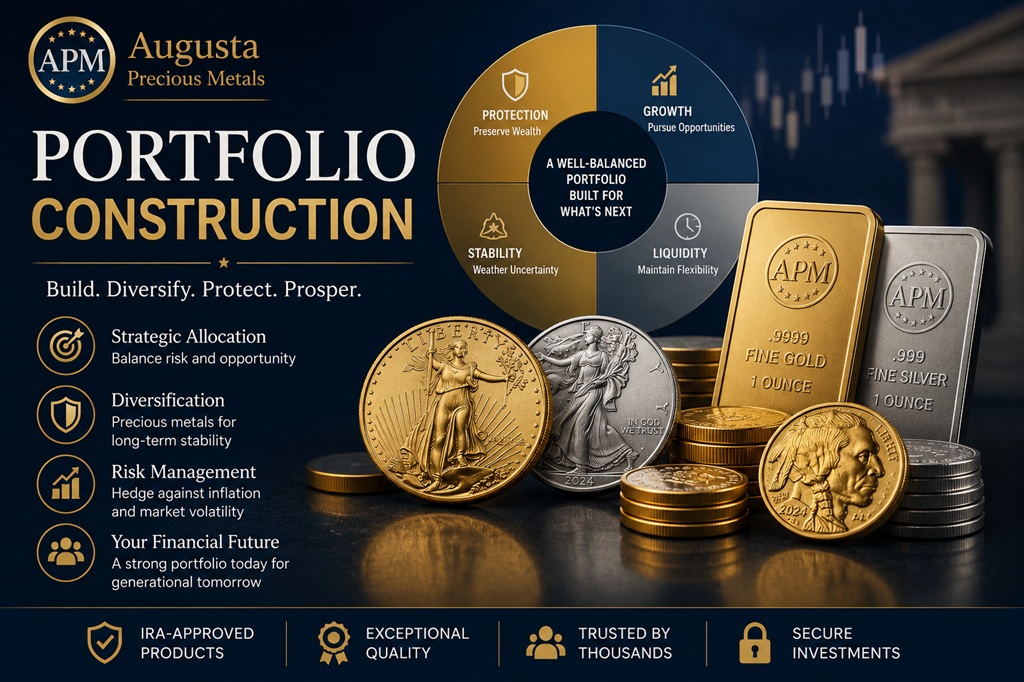
How Much of a Portfolio Should Go Into Gold and Silver?
There is no single right percentage. How much of a portfolio belongs in gold and silver depends on a saver’s goals, time horizon, and risk tolerance, and most plans treat physical metals as a minority position rather than the core holding. The suitable share is a question for a licensed fiduciary.
Why does the number vary so much? Because portfolios start from different places. A saver with a long horizon and other diversified holdings sits in a different spot than one near retirement with concentrated assets. Augusta Precious Metals frames a gold IRA as a long-term diversification tool rather than a get-rich-quick investment, with metals meant to hold a portion of a plan rather than the whole. The right portion depends on the individual saver. Always set the percentage with a licensed fiduciary who knows your full financial picture, not from a generic rule of thumb.
Why Hold Gold and Silver in a Retirement Portfolio?
A retirement portfolio holds gold and silver mainly for diversification. According to the Securities and Exchange Commission, spreading money among different investments reduces risk, because asset categories whose returns move up and down under different conditions can offset one another and protect against significant losses.
How does that apply to the metals? Physical gold and silver have historically not moved in lockstep with stocks and bonds, so a modest position can act as a counterweight when paper assets fall. That is the diversification case in a sentence. It is not a promise of gains, since bullion carries its own price risk, but it is the reason a long-term saver might hold a slice. The same investor education stresses that the goal is managing risk across categories, not chasing any single one. A position sized to that purpose looks very different from a speculative bet.
What Can You Hold in an Augusta Gold IRA?
An Augusta gold IRA holds IRA-eligible gold coins, silver coins, gold and silver bars, and a premium coins program. Under IRC 408(m)(3), gold must be at least 99.5 percent pure and silver at least 99.9 percent, or qualify as a named statutory coin, which is what keeps these products inside a retirement account.
What falls outside it? The exotic and the paper. Augusta does not offer platinum, palladium, mining stocks, exchange-traded funds, or paper gold, so portfolio construction here means choosing among physical gold and silver in coins and bars. The full menu sits on the product catalog, which maps every category and links to a guide for each. For most savers the practical decisions are the metal split and the coin-versus-bar mix, not an exotic sleeve. That narrow set of choices is part of what keeps the eligibility simple.

How Should a Saver Split Gold and Silver?
A gold-and-silver split is a personal choice, not a fixed formula. Augusta positions silver for portfolio balance rather than speculation, and savers often pair it with gold in a split such as 50/50 or 70/30, depending on their own preference and how much short-term price movement they are willing to hold.
Why might the mix tilt one way? It comes down to risk and budget. Silver costs less per coin, which lets a saver add in smaller increments, but it is more volatile and takes more space to store per dollar. Gold is steadier and denser in value, so a buyer who wants a calmer position leans toward it, while one who wants accessibility leans toward silver. Neither split is right or wrong, and Augusta leaves the choice with the customer rather than steering it. Always weigh the split against your own goals and a professional’s input before committing to one.
What Factors Shape the Right Allocation?
Three factors shape a metals allocation more than any rule of thumb: time horizon, risk tolerance, and what a saver already holds. The Securities and Exchange Commission points to time horizon and risk tolerance as the central inputs to any asset allocation, since a longer horizon and a higher tolerance for swings support a different mix than a short horizon does.
How do the factors interact? They set the boundaries. A long horizon gives metals time to play their diversification role through market cycles, a higher risk tolerance makes short-term price swings easier to hold, and a plan already heavy in one asset shapes how much metal adds real balance. Existing concentration often matters most, since bullion does the most work when it offsets something a saver already owns. That yields no fixed number, which is exactly why the allocation belongs with a professional rather than a generic chart.
Does Augusta Give Allocation Advice?
Augusta does not give individualized allocation advice. It provides education about how a precious-metals IRA works, but the specific percentage a saver should hold belongs with a licensed fiduciary who knows the full financial picture. Augusta’s salaried, education-first model is built to inform that decision rather than to make it for you.
Why is that line worth drawing? Because allocation is personal. A dealer can explain the building blocks, the eligibility rules, and the gold-silver trade-offs, but matching them to one saver’s tax situation and goals is fiduciary work. Money magazine has named Augusta Precious Metals as Best Overall Gold IRA Company every year from 2022 through 2025, which is a signal about the dealer rather than advice about your mix. For the full product menu, see the gold IRA overview. Always confirm your allocation with a licensed professional before funding an account.
Risk Warning: Precious metals investments carry risk, including the possible loss of principal. Gold and silver prices can fluctuate based on macroeconomic conditions, currency movements, and market sentiment. Past performance is not a guarantee of future results. A gold IRA is a long-term diversification tool, not a short-term trading vehicle, and no article can tell you the right allocation for your situation. Always consult your own licensed legal, financial, and tax professionals before deciding how much of a portfolio to hold in precious metals.
About the Editorial Team
Augusta Precious Metals Reviews is the editorial site covering Augusta Precious Metals. We publish articles about Augusta’s products, leadership, fees, customer experience, and gold IRA process under an editorial team byline. Our coverage cites named third-party authorities, including the U.S. Securities and Exchange Commission and Money magazine, alongside Augusta’s own published positioning. We do not publish urgent, scarcity-driven, or high-pressure content, and we never recommend a specific allocation. We close every educational article with a soft reminder to speak with your own legal, financial, and tax professionals before investing.
Disclosure: This site has a partnership relationship with Augusta Precious Metals and may earn a commission from accounts opened through the contact methods on this site, in line with the Federal Trade Commission affiliate-disclosure rules under 16 CFR Part 255. Editorial coverage reflects Augusta’s published positioning and the current rules governing self-directed precious-metals IRAs.
Disclaimer: This article is for informational purposes only and does not constitute financial, tax, or legal advice. It does not recommend any specific allocation. Consult a qualified professional before making investment decisions.