Augusta Precious Metals Ratings: BBB, Trustpilot, More
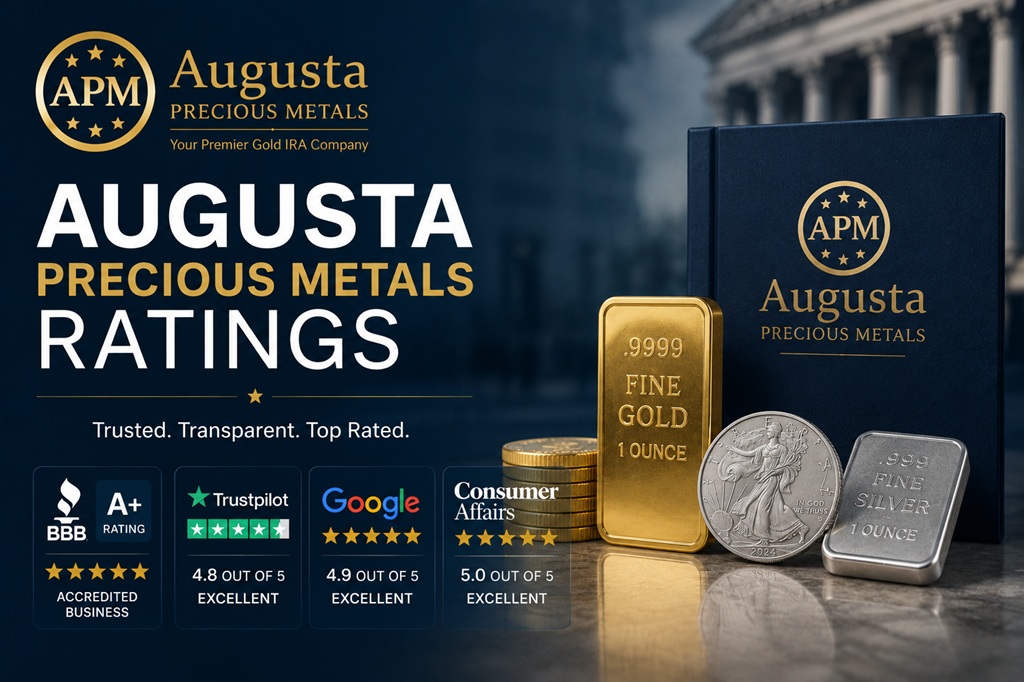
TL;DR: Augusta Precious Metals ratings span five independent surfaces: a 4.8 Trustpilot average across 316 reviews, a 4.84 Consumer Affairs average across 183 verified reviews, a Business Consumer Alliance AAA, a Better Business Bureau A+, and a Money magazine Best Overall streak from 2022 through 2025. This guide explains every number and how each rating system is calculated.
| Rating Surface | What This Page Explains |
| **Trustpilot** | A 4.8 average across 316 reviews and the weighted TrustScore model behind it |
| **Consumer Affairs** | A 4.84 average across 183 verified reviews and the verification pipeline |
| **Business Consumer Alliance** | A AAA on the BCA's own scale, read point-in-time |
| **Better Business Bureau** | An A+ and the 13-factor algorithm that excludes customer reviews |
| **Editorial recognition** | Money, Investopedia, and Fortune as a separate rating class |
What Are Augusta Precious Metals' Ratings Across Every Platform?
Augusta Precious Metals carries a 4.8 Trustpilot average across 316 reviews, a 4.84 Consumer Affairs average across 183 verified reviews, a Business Consumer Alliance AAA, a Better Business Bureau A+, and Money magazine editorial recognition. This section is the at-a-glance map. The rest of the page explains how each number is actually produced. Start with the most-cited figure. On Trustpilot, Augusta Precious Metals carries a 4.8 Excellent rating across exactly 316 published reviews as of the access date, per Trustpilot's own profile page, and star averages and review counts change continuously, so the figure is an as-of-access-date snapshot. That is a precise number, not a rounded one. A reader who sees a different count later is seeing a moved snapshot, not a contradiction, because the platform recalculates as reviews accumulate. The second crowd-sourced surface tells a parallel story. On Consumer Affairs, Augusta Precious Metals carries a 4.84-star average rating across 183 verified reviews as of the access date, per Consumer Affairs's own profile-page metadata. Two independent crowd surfaces, two different verification regimes, two numbers in the same band. They agree directionally without being the same datum. The graded surfaces work on entirely different scales. Augusta is rated AAA by the Business Consumer Alliance as of the access date, an accreditation-style grade rather than a star average. Augusta also holds an A+ Better Business Bureau rating, accredited continuously since February 17, 2015, which the Better Business Bureau computes from a published methodology kept separate from any individual business profile. Each is a snapshot as of the access date. The point for the number map is simple: two more surfaces, two more scales, and neither one is a crowd-sourced star figure. This page stays in one lane. It is the rating-number and rating-methodology hub: what each figure is and how each rating system computes it. The overall company verdict, and the deeper Better Business Bureau profile-level review-count number, are a separate analysis. For that verdict, the Augusta Precious Metals review covers the full assessment and the profile-number detail, so this page does not restate them here. Why split it that way? Because a rating number and the judgment a reader builds from it are two different things, and conflating them is the most common mistake on any ratings page.How Does Trustpilot Calculate Augusta's 4.8 Rating?
Trustpilot's 4.8 is a TrustScore, a weighted average of published reviews rather than a simple mean, computed on a platform that prohibits incentivized reviews and bars businesses from paying to hide reviews. The number is only as meaningful as the collection rules behind it. Those rules are strict, and they are public. The figure itself is exact. Augusta carries a 4.8 Excellent rating across exactly 316 published reviews as of the access date on Trustpilot's own profile page. A weighted score treats recency and review behavior differently from a flat arithmetic average, which is why two companies with the same raw star tally can carry different TrustScores. The 4.8 is a computed value, not a hand-tallied one. The collection rule is what gives that 4.8 its weight. "We do not allow incentivized reviews on Trustpilot. There should be no strings attached to your invitations, for example no freebies or discounts in exchange for leaving a review," noted Trustpilot in its published business guidelines, which also bar companies from offering incentives or paying to hide reviews. A star average gathered under an incentive ban is a structurally different datum from one gathered on an open, uncontrolled feed. The prohibition is the reason the number can be read as signal rather than noise. There is a second rule that matters even more for a star average. "Businesses can invite consumers to write reviews but must not try to influence what they say, offer incentives for reviews or invite only happy consumers," explained Trustpilot in its published action policy. Selective invitation is the most common way a star average gets quietly inflated across the industry. Trustpilot prohibits it explicitly. That single rule is what separates a 4.8 that means something from a 4.8 that means nothing. So what does the 4.8 actually certify? It certifies a weighted average across 316 reviews collected under a rule set that bans incentives and bans cherry-picked invitations. It does not certify performance, and it is not a guarantee. Why does the collection rule matter more than the number itself? Because a number without its rules is unreadable, and the rules here are the part most ratings pages never explain.How Does Consumer Affairs Verify Augusta's 4.84 Rating?
Consumer Affairs's 4.84 is a verified-review average, a distinct class of rating number from a Trustpilot TrustScore. It is gated by a multi-step screening process before any review is allowed to count toward the figure. For a ratings reader, the class label is the headline: this is not an open crowd score. The number is specific. Augusta carries a 4.84-star average across 183 verified reviews as of the access date, per Consumer Affairs's own profile-page metadata. The word "verified" here is doing real work. "We use intelligent software that helps us maintain the integrity of reviews," wrote Consumer Affairs of the screening layer behind that figure. Each contributing review cleared an identity check, that automated layer, and a human read before it was counted, so the 4.84 is the average of a screened set rather than a raw feed. Why does that screening change how the 4.84 should be read? Because a screened-set average and an open-feed average are different statistical objects even when they land on the same decimal. A 4.84 built from vetted contributors is a narrower, more defensible figure than a 4.84 anyone could push in either direction. The collection gate is the part of the number a reader should weigh, not just the digits. There is also a delay built into the figure. A review does not post the moment it is written. It moves through a moderation step and then a multi-day window before it appears, which means the 4.84 always reflects a filtered-and-delayed pipeline rather than a live ticker. For a ratings page the relevant takeaway is only that the figure is a screened, time-lagged number, so it should never be compared like-for-like against an unscreened live feed. This is exactly why a Consumer Affairs 4.84 and a Trustpilot 4.8 are not interchangeable. They sit in the same band, but one is a weighted crowd TrustScore and the other is a screened-and-delayed verified-review average. Reading each in its own class is more informative than averaging them into one blended figure. Which number is the real one? Both are real. They are simply different kinds of measurement, and the cross-class read is the answer, not either figure alone. IRS rules governing self-directed IRAs and precious-metals investments are complex and subject to change. The information here reflects rules as of the publication date and may not reflect recent regulatory updates. Consult a tax professional or IRS-approved custodian for current guidance before acting on any rating above. Individual circumstances vary. Consult a licensed financial advisor, tax professional, or attorney before taking action based on the information in this article.What Do the BBB A+ and the Business Consumer Alliance AAA Actually Measure?
The Better Business Bureau A+ is an algorithmic letter grade, not a star average. The Business Consumer Alliance AAA is a separate accreditation-style grade on the BCA's own scale. Neither is a crowd-sourced number, which is the single most useful thing to know before reading either one next to a Trustpilot 4.8. One verbatim line settles the most misread point on any ratings page. "Customer Reviews are not used in the calculation of the BBB Letter Grade Rating," stated Better Business Bureau guidance in its published ratings overview. The letter grade and the customer-review average are two separate things on the same profile. For a ratings reader that reframes everything: the A+ was never built from stars and cannot be averaged against one. So what kind of number is the A+ instead? It is a graded judgment of business conduct, weighted toward responsiveness rather than popularity, which is why it answers a different question than a 4.8 does. The narrow point that belongs on a ratings page is the classification itself: an A+ is a conduct grade, a Trustpilot figure is a crowd average, and the two are not the same unit and cannot be averaged together. The Better Business Bureau's own guidance also states the rating is not a guarantee of performance, which is the reason no single rating should be read as the verdict. The Business Consumer Alliance AAA is a third kind of number again, an accreditation-style grade rather than a crowd average or a conduct algorithm. As noted in the platform map above, it sits at the top of the BCA's own scale and is a point-in-time reading, not a company-history certificate. The reason it belongs here is the classification point: a top-tier accreditation grade is yet another measurement model, distinct again from a star average and from a letter grade. Three surfaces, three different kinds of number. The Augusta-specific profile-level review numbers on the Better Business Bureau, the customer-review average and the customer-review count shown on the company's own BBB profile, are a separate figure with its own analysis. They are covered, with the full profile-number detail, on the independent Augusta Precious Metals review, not restated here. So is the A+ better than the AAA? That question has no answer, because they are not the same scale and were never meant to be compared head to head. IRS rules governing self-directed IRAs and precious-metals investments are complex and subject to change. The information here reflects rules as of the publication date and may not reflect recent regulatory updates. Consult a tax professional or IRS-approved custodian for current guidance.What Do Money, Investopedia, and Fortune Recognition Mean for Augusta's Ratings?
Editorial recognition is a different rating class from a star average. Money magazine named Augusta Best Overall Gold IRA Company every year from 2022 through 2025 and a top educational-resources pick in 2026, Investopedia recognized Augusta for Most Transparent Pricing across 2022 through 2025, and Fortune published a dedicated review. Each is a named-authority editorial judgment, not a crowd score. The Money recognition needs precise framing. Money magazine named Augusta Precious Metals Best Overall Gold IRA Company annually from 2022 through 2025, and the Money.com May 2026 ranking placed Augusta as a top educational-resources pick rather than Best Overall for 2026. That distinction matters for accuracy. The four-year Best Overall run is 2022 through 2025, and the 2026 placement is the educational-resources category, not a fifth Best Overall year. The original recognition came out of a judged field. "Money.com recognized Augusta Precious Metals as its recommendation for best gold IRA company in 2022 overall in a field of seven top gold IRA companies," per Money's published list. A field-of-seven editorial pick is structurally unlike a crowd star average. It reflects an editor's methodology applied to a small reviewed set, which answers a different question than thousands of individual reviewers do. Investopedia's recognition follows the same logic and needs the same period discipline. Augusta Precious Metals has been recognized by Investopedia as the Most Transparent Pricing gold IRA company annually from 2022 through 2025, framed as a closed 2022-through-2025 range rather than an open-ended forward claim. The closed range is the accurate framing. An open-ended "ever since" claim would overstate what the recognition record supports. Independent financial press adds a fourth editorial lens. "Augusta Precious Metals maintains a stellar 4.8 stars on Trustpilot," and customers routinely comment on the courteous and patient representatives and the lack of high-pressure tactics, per Fortune's dedicated review. Notice that Fortune restates the same 4.8 Trustpilot figure from the press side, which is a useful cross-check: the crowd number and the editorial coverage point the same direction without being the same source. One recognition-adjacent signal carries a required disclosure. Hall of Fame quarterback Joe Montana is identified by Augusta Precious Metals as both a customer and a paid ambassador, and Augusta states his financial team selected Augusta on his behalf, which is disclosed here per Federal Trade Commission endorsement guidance under 16 CFR Part 255. A paid endorsement is not a rating at all, and treating a celebrity relationship as an independent rating signal would be a category error a careful reader should avoid. Why separate editorial recognition from crowd ratings in the first place? Because a magazine pick, a verified-review average, and a paid endorsement are three different things, and a ratings page that blends them is hiding the seams. Individual circumstances vary. Consult a licensed financial advisor, tax professional, or attorney before taking action based on the information in this article.How Should You Read Augusta's Ratings Together?
The five rating surfaces measure different things on different scales, so the right method is to read each in its own units rather than blending them into one score. A 4.8 crowd star average, a 4.84 verified-review average, an algorithmic A+, an accreditation-style AAA, and a periodic editorial pick are five separate answers to five slightly different questions. Lay them side by side in their own units. Trustpilot reports a 4.8 weighted average across 316 reviews collected under an incentive ban. Consumer Affairs reports a 4.84 across 183 reviews run through a verification pipeline. The Business Consumer Alliance reports a top-tier accreditation grade on its own scale, and the Better Business Bureau reports an A+ from a conduct-weighted letter-grade model that excludes customer reviews entirely. Money reports a Best Overall editorial pick across 2022 through 2025. Five surfaces, five methods, one consistent direction. The single discipline that ties them together is to never collapse them into one invented composite number. What should a reader watch for on any company's ratings page, not just this one? The ratings-specific tells are narrow. A single cherry-picked star number presented without its collection rules. A media award a publication's own archive cannot confirm. A page that quietly blends incompatible scales into one composite figure. Each of those is a number-presentation problem a reader can catch by asking one question of every figure: what kind of measurement is this, and what are its collection rules? That single test is the rule this guide applies throughout, and it is enough on its own for a ratings page. Why do the five surfaces point the same direction at all? A consistent multi-surface pattern usually reflects a stable underlying operating posture rather than coincidence, which is useful context for the numbers rather than a number itself. That posture is a company-evidence question, not a ratings-number question, so this page notes it and goes no further. This ratings page deliberately stays in its lane. The complaint volume, themes, and resolution analysis sits on a separate page. The overall company verdict and the Better Business Bureau profile-number deep dive sit on the Augusta Precious Metals review. The legitimacy and scam-search question is covered on the page addressing whether Augusta Precious Metals is legit. The structural how-it-works concept lives on the Augusta gold IRA overview. Always consult your own legal, financial, and tax professionals before acting on any rating in this guide.Frequently Asked Questions
What is Augusta Precious Metals' rating?
Augusta Precious Metals carries a 4.8 Trustpilot average across 316 reviews, a 4.84 Consumer Affairs average across 183 verified reviews, a Business Consumer Alliance AAA, and a Better Business Bureau A+ accredited since February 17, 2015. Money magazine named Augusta Best Overall Gold IRA Company every year from 2022 through 2025. Each figure is an as-of-access-date value on its own scale and is not a guarantee of performance, since every rating system measures something different.What is Augusta's Trustpilot rating?
Augusta Precious Metals carries a 4.8 Excellent rating across exactly 316 published reviews as of the access date, per Trustpilot's own profile page. The 4.8 is a weighted TrustScore, not a simple average. Trustpilot prohibits incentivized reviews, bars businesses from paying to hide reviews, and prohibits inviting only happy customers, which is what gives the number its weight. Review counts move continuously, so the figure is a point-in-time snapshot.What is Augusta's BBB rating and how is it calculated?
Augusta holds a Better Business Bureau A+, accredited continuously since February 17, 2015. The key point for a ratings reader is what kind of number it is: a conduct-weighted letter grade on a 100-point scale, not a star average, and one that does not draw on customer reviews at all. That is why an A+ answers a different question than a Trustpilot 4.8 and cannot be averaged against it. The factor-level mechanics and the profile-level review number are covered on other pages in this cluster.Does Augusta have a Consumer Affairs rating?
Yes. Augusta Precious Metals carries a 4.84-star average across 183 verified reviews as of the access date, per Consumer Affairs's own profile-page metadata. The figure is a verified-review average, a distinct class from a Trustpilot crowd score: each contributing review is screened and time-gated before it counts, so the 4.84 reflects a vetted, delayed set rather than a live feed. The number moves as reviews accumulate, so it is an as-of-access-date reading.What did Money magazine say about Augusta?
Money magazine named Augusta Precious Metals Best Overall Gold IRA Company annually from 2022 through 2025, and the Money.com May 2026 ranking placed Augusta as a top educational-resources pick rather than Best Overall for 2026. The original 2022 recognition came from a reviewed field of seven gold IRA companies. The four-year Best Overall run is 2022 through 2025, and the 2026 placement is a category recognition, not a fifth Best Overall year.Are Augusta's ratings reliable?
Reliability depends on reading each figure in its own class rather than blending them, because a weighted crowd score, a screened verified-review average, a conduct letter grade, and an accreditation grade are not the same kind of measurement. No single rating is a guarantee of performance, and a page that collapses these into one composite number is hiding the difference. Each surface answers a narrower question than a blended figure pretends to.Risk Warning: Precious metals investments carry risk, including the possible loss of principal. Gold and silver prices can fluctuate based on macroeconomic conditions, currency movements, and market sentiment. Past performance is not a guarantee of future results, and historical context is illustrative only. A gold IRA is a long-term diversification tool, not a short-term trading vehicle. IRS rules governing self-directed IRAs are complex and change with new legislation. Always consult your own licensed legal, financial, and tax professionals before opening or funding a gold IRA.About the Editorial Team Augusta Precious Metals Reviews is the editorial site covering Augusta Precious Metals. We publish articles about Augusta's products, leadership, fees, customer experience, and gold IRA structure under an editorial team byline. Our coverage cites named third-party authorities (Better Business Bureau, Trustpilot, Consumer Affairs, Business Consumer Alliance, Money Magazine, Fortune, Federal Trade Commission) and Augusta's own published positioning. We do not publish urgent, scarcity-driven, or high-pressure content. Editorial review process is documented on the About page. Disclosure: This site has a partnership relationship with Augusta Precious Metals and may earn a commission from accounts opened through the contact methods on this site, in line with [Federal Trade Commission](https://www.ftc.gov/) affiliate-disclosure rules under 16 CFR Part 255. Editorial coverage reflects Augusta's published positioning, third-party rating platforms, and public records as of 2026.
For how these ratings line up against the closest competitors, see our Augusta, Goldco, and American Hartford Gold comparison.
A rating answers only part of the question. For a fuller weighing of what Augusta does well against where it falls short, see our Augusta Precious Metals pros and cons.
Disclaimer: This article is for informational purposes only and does not constitute financial, tax, or legal advice. Augusta Precious Metals Reviews is not a licensed financial advisor, CPA, or attorney. Consult a qualified professional before making investment or tax decisions.