Augusta Gold IRA Rollover Process: Step-by-Step Walkthrough
TL;DR: Funding an Augusta gold IRA follows four moves: open a self-directed IRA with an approved custodian, fund it through a direct transfer or a rollover, select IRA-eligible gold and silver, and let the custodian store the metal at an approved depository. A transfer is the simplest path because the saver never takes possession. The custodian handles the IRS reporting, and Augusta’s dedicated agent guides each step. This guide walks the full journey and links to the detailed mechanics for each funding method.
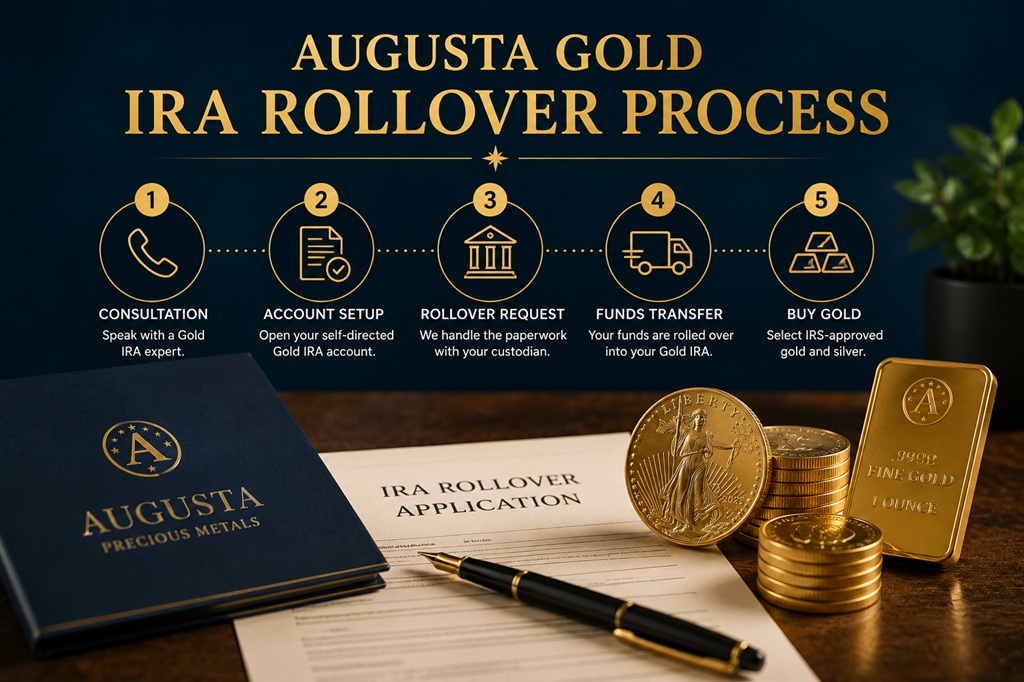 Rolling retirement savings into an Augusta gold IRA follows a clear path from start to finish: open a self-directed account, move the money in through a transfer or rollover, choose the metals, and let the custodian store them at an approved depository. Money magazine has named Augusta Precious Metals as Best Overall Gold IRA Company every year from 2022 through 2025, and its education-first onboarding is built to walk a saver through each step without pressure. This walkthrough covers the full journey end to end and links to the detailed mechanics for each funding method.
Rolling retirement savings into an Augusta gold IRA follows a clear path from start to finish: open a self-directed account, move the money in through a transfer or rollover, choose the metals, and let the custodian store them at an approved depository. Money magazine has named Augusta Precious Metals as Best Overall Gold IRA Company every year from 2022 through 2025, and its education-first onboarding is built to walk a saver through each step without pressure. This walkthrough covers the full journey end to end and links to the detailed mechanics for each funding method.
Step 1: Open a Self-Directed Gold IRA
The process starts by opening a self-directed IRA, the account type that can legally hold physical metal. According to Augusta Precious Metals, Equity Trust Company is its number-one recommended custodian, with GoldStar Trust Company or Kingdom Trust as alternates, while Augusta serves as the metals dealer and assigns a dedicated agent to the account. Who does what here? The roles split cleanly. The custodian administers the account and holds title to the metal, Augusta supplies the metal and the education, and the saver keeps full ownership under their own name. Augusta applies a 50,000-dollar minimum to open, which is higher than some dealers and reflects its focus on rollover-sized retirement accounts. A dedicated agent stays with the account through every later step, so the same person who helps open the account also helps fund it.Step 2: Choose How to Fund the Account
With the account open, the next decision is how to fund it. An Augusta gold IRA accepts two paths, a direct transfer that moves money custodian to custodian, or a rollover in which a distribution is paid out and then redeposited into the new account within the deadline the rules set. Which path is right? It depends on the source account, and each has its own detailed guide:- A transfer is the simplest, since the saver never touches the money. The trustee-to-trustee transfer walkthrough covers it step by step.
- A rollover splits into two types, and the direct versus indirect rollover guide weighs the trade-offs.
- An indirect rollover starts a strict clock, explained in the 60-day rollover rule guide.
Step 3: Initiate the Transfer or Rollover
Once the funding path is chosen, the saver initiates it through the receiving custodian rather than the old one. The new custodian sends the paperwork to the current institution and requests the funds, and Augusta’s dedicated agent helps assemble the prior-account details the form needs. What does the saver actually do? Less than most expect. For a transfer, the custodians settle directly, so the main task is supplying account numbers and signing the request. For a rollover, the saver may receive the funds and must redeposit them on time. Either way the dedicated agent tracks the paperwork, and the custodian, not Augusta, executes the money movement and the reporting that follows. Keeping a direct path here is what avoids deadlines and withholding.Step 4: Select Your IRA-Eligible Metals
After the account is funded, the saver picks the metals. These must be IRA-eligible, meaning gold at least 99.5 percent pure and silver at least 99.9 percent, or a named statutory coin, under IRC 408(m)(3). How does a saver choose among them? By cost and goal. Coins offer recognition and divisibility, while bars carry the lowest premium for bulk metal, and most positions blend the two across gold and silver. The full menu, with a guide for each category, sits on the product catalog page. A dedicated agent can walk through what is currently in stock, though the final selection is always the saver’s own call. The choice is locked in before the custodian completes the purchase.Step 5: Confirm Storage at the Depository
The final step is storage. Once the metals are purchased, the custodian ships them to an IRS-approved depository, which for Augusta is primarily the Delaware Depository in Wilmington, with vault contents insured under Lloyd’s of London and the metal held in the account holder’s name. How does a saver know it is done? The paperwork confirms it. Home storage is not allowed for IRA metal, so the depository step is what keeps the account compliant. The custodian reports the rollover or transfer to the tax authorities, recording contributions and rollovers on Form 5498 and any later distribution on Form 1099-R. After that the account is funded, stocked, and stored, and the saver can track the holding through the custodian’s online portal.Frequently Asked Questions
How Long Does an Augusta Gold IRA Rollover Take?
The timeline varies, and most of it sits outside Augusta’s hands. The biggest variable is how quickly the previous custodian releases the funds, which differs by institution. A direct transfer is generally quicker than an indirect rollover, since no distribution check has to be issued and redeposited. The dedicated agent tracks the request to keep it moving.Can a 401(k) Fund an Augusta Gold IRA?
Yes. A 401(k) from a former employer can fund an Augusta gold IRA, and so can a traditional IRA, a 403(b), or a similar qualified account. A current employer’s active 401(k) may be restricted until you leave or reach a plan-defined age, which the plan administrator confirms. The dedicated agent helps identify which accounts are eligible to move.Will a Rollover Trigger Taxes or Penalties?
A correctly executed direct transfer or direct rollover triggers no taxes or penalties, because the money never leaves the tax-deferred system. An indirect rollover is where the risk sits, since missing the redeposit deadline can make the distribution taxable and add an early-withdrawal penalty. Staying on a direct path avoids that clock entirely.Who Handles the Paperwork and IRS Reporting?
The custodian handles the official paperwork and tax reporting, not Augusta. The custodian records contributions and rollovers on Form 5498 and any distribution on Form 1099-R, while Augusta’s dedicated agent gathers the prior-account details and keeps the request moving. The saver signs the forms but does not have to manage the filings.What Is the Difference Between a Transfer and a Rollover?
A transfer moves money directly between two custodians without the saver taking possession, while a rollover sends the funds to the saver first, who then redeposits them into the new account. A transfer has no deadline and is not reported as a distribution, which makes it the simpler path. The two dedicated guides cover each in full.Risk Warning: Precious metals investments carry risk, including the possible loss of principal. Gold and silver prices can fluctuate based on macroeconomic conditions, currency movements, and market sentiment. Past performance is not a guarantee of future results. A gold IRA is a long-term diversification tool, not a short-term trading vehicle. IRS rules governing self-directed retirement accounts and rollover mechanics are complex and change with new legislation. Always consult your own licensed legal, financial, and tax professionals before opening or funding a gold IRA.About the Editorial Team Augusta Precious Metals Reviews is the editorial site covering Augusta Precious Metals. We publish articles about Augusta’s products, leadership, fees, customer experience, and gold IRA process under an editorial team byline. Our coverage cites named third-party authorities, including the Internal Revenue Service and Money magazine, alongside Augusta’s own published positioning. We do not publish urgent, scarcity-driven, or high-pressure content. We close every educational article with a soft reminder to speak with your own legal, financial, and tax professionals before investing. Disclosure: This site has a partnership relationship with Augusta Precious Metals and may earn a commission from accounts opened through the contact methods on this site, in line with the Federal Trade Commission affiliate-disclosure rules under 16 CFR Part 255. Editorial coverage reflects Augusta’s published positioning and the current rules governing self-directed precious-metals IRAs.
New to the mechanics? Our overview of how a gold IRA rollover works walks through each step.
Federal employees can roll a Thrift Savings Plan into a gold IRA the same way.
Disclaimer: This article is for informational purposes only and does not constitute financial, tax, or legal advice. Consult a qualified professional before making investment decisions.