The Home-Storage Gold IRA Myth, Explained
TL;DR: The home-storage gold IRA is a myth the tax rules do not support. IRC 408(m)(3) requires IRA metal to be held by an IRS-approved trustee, not in a personal safe, and the U.S. Tax Court confirmed this in McNulty v. Commissioner, where storing IRA coins at home triggered a taxable distribution and penalties that exceeded $300,000. A compliant gold IRA stores metal at an approved depository under a custodian's account.
| The Claim vs The Rule | What's True |
| **The pitch** | Hold IRA gold at home through an LLC |
| **The statute** | IRC 408(m)(3) requires a trustee to hold the metal |
| **The case** | McNulty v. Commissioner rejected home possession |
| **The cost** | A taxable distribution, plus possible penalties |
| **The compliant path** | Storage at an approved depository |
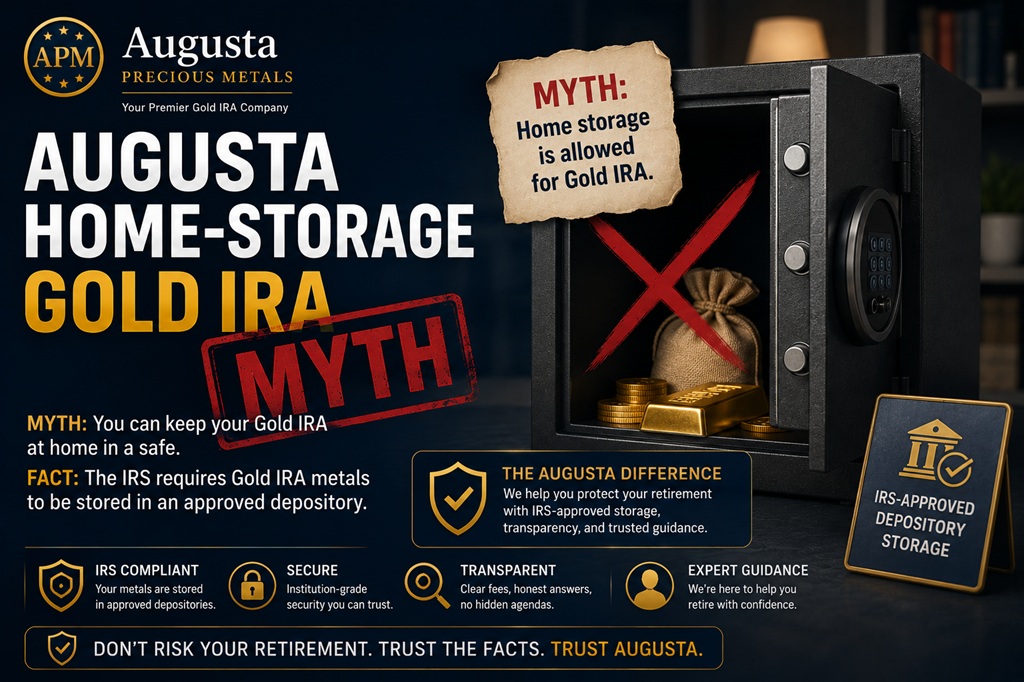
What Is the Home-Storage Gold IRA Myth?
A home-storage gold IRA promises something the tax code does not allow, that you can hold your IRA's gold in a safe at home and keep the account's tax advantages. The pitch usually runs through a limited liability company that the IRA owns, with the account holder acting as manager and taking the coins home. It sounds clever. It does not survive contact with the statute.
The reality is narrower than the marketing. Federal law lets an IRA hold specific precious-metals coins and bars, but it attaches a condition to that permission, and the condition is about who holds the metal. The rule requires an approved trustee to keep the metal, which is precisely the part a home-storage arrangement tries to skip.
Why does the myth persist if the rule is clear? Because the marketing is built around a real statute and a real account structure, then stretched one step too far. A self-directed IRA is real. An IRA-owned LLC is real. The leap that fails is the account holder pocketing the coins, and that leap is the entire point of the home-storage pitch.
Why does this matter to an ordinary saver? Because the people most drawn to home storage are often the most exposed if it fails. A saver who wants control of their metal is the exact audience the pitch targets, and that same saver is the one who absorbs the tax bill when the arrangement unwinds. The rule is free to learn in advance. Discovering it through a Form 1099-R is not.
This article walks the rule, the case that tested it, and the tax bill that follows when the arrangement unwinds. The goal isn't to scare anyone off gold IRAs. The goal is to separate a legitimate retirement structure from a marketing claim that has already cost taxpayers money. Always consult your own legal, financial, and tax professionals before acting on any retirement-account strategy.
What Does IRC 408(m)(3) Actually Require?
The governing statute is IRC § 408(m)(3), and it does two things at once. It carves specific gold, silver, platinum, and palladium coins and bullion out of the general prohibition on collectibles in section 408(m)(2), and it attaches a condition to that carve-out. The metal has to be in the physical possession of an IRS-approved trustee.
That condition is the whole ballgame. Without the carve-out, precious metals would be collectibles an IRA cannot hold at all. The carve-out is what makes a gold IRA possible, and it comes with the trustee-possession requirement baked in. You cannot accept the permission and decline the condition, because they are the same sentence of the law.
What counts as a trustee here? A bank or an IRS-approved nonbank trustee, the kind of institution that holds the account and answers to federal oversight. An individual account holder standing in a kitchen does not qualify, no matter what title an LLC operating agreement assigns. The statute ties eligibility to a specific kind of custodian, not to a clever ownership chain.
Why did Congress attach a trustee condition at all? Because the point of the carve-out was never to let savers stockpile coins personally. The exception exists so retirement accounts can diversify into metal through a regulated custodian, with the same oversight that applies to other IRA assets. Without the trustee, the policy reason for the carve-out disappears, which is why the courts read the condition as central rather than incidental. That reading is what every home-storage workaround eventually collides with.
So the answer the statute gives is plain. Eligible metal, held by an approved trustee, is a gold IRA. The same metal in a home safe is something the carve-out never authorized. Everything in the home-storage debate flows from that single requirement, and the next question is what happens when someone tests it.
How Did McNulty v. Commissioner Settle the Question?
McNulty v. Commissioner is the case that took the home-storage theory to court, and the theory lost. The taxpayers set up a self-directed IRA, used it to own an LLC, bought American Eagle coins through that LLC, and stored the coins in a safe at home. On paper the structure looked like the home-storage pitch in action. The U.S. Tax Court treated it as exactly what it was.
The court's holding was direct. Taking physical possession of the coins, even through an IRA-owned LLC, was a taxable distribution equal to the cost of the coins. The carve-out in section 408(m)(3), the court reasoned, requires the metal to sit with a trustee, and an account holder who controls and possesses the metal has not met that requirement. The ownership chain didn't change the outcome.
The language the court used is worth reading in full. "An owner of a self-directed IRA may not take actual and unfettered possession of the IRA assets," the U.S. Tax Court wrote in its 2021 decision, reported as 157 T.C. No. 10. That sentence is the reason home-storage marketing now runs into a wall, because a court of record has already addressed the exact arrangement and called it a distribution.
Why does one case carry so much weight? Because it is a court of record addressing the precise structure the marketing sells, not a vague warning. A Tax Court opinion binds the parties and guides the IRS as well as other taxpayers facing the same facts. Before McNulty, home-storage promoters could lean on the absence of a direct ruling, treating silence as permission. After it, the direct ruling exists, and it went against the arrangement on facts that mirror the standard pitch. That shift is why the case anchors every honest discussion of home storage, and why a promoter who never mentions it is leaving out the most relevant fact in the conversation.
What did the outcome cost? The back-taxes and penalties in the case exceeded $300,000. That figure is the practical translation of the holding, the difference between a compliant account and a confident misreading of the statute. Any company still marketing a home-storage IRA is offering an arrangement the Tax Court has already disposed of. Always consult your own tax professional before relying on any structure that promises home possession of IRA metal.
What Happens If You Store IRA Metals at Home?
Home storage triggers a specific and unforgiving tax outcome, the deemed distribution. The Internal Revenue Service treats a retirement account that acquires a collectible as receiving a distribution in the year the collectible is acquired, equal to the cost of the collectible. When the carve-out's conditions aren't met, the metal reverts to collectible treatment and that rule kicks in.
The mechanics are concrete. The deemed distribution is reported to the account holder on Form 1099-R, and the amount is generally taxed as ordinary income in the year of the distribution. For a traditional IRA, that means the full distributed amount lands on the tax return as income, taxed at the holder's regular rate rather than any preferential rate.
When does the tax actually hit? In the year the account is treated as acquiring the collectible, which for a home-storage arrangement is the year the metal lands in the holder's possession. The custodian or the IRS reporting reflects it, the holder reports the amount as income, and the bill arrives with that year's return. There is no grace period built into the rule, and discovering the problem late does not reset the clock.
There's a second layer for younger savers. The 10 percent additional tax on early distributions under IRC § 72(t) can apply when the account holder is under age 59 and a half, unless a statutory exception fits. Stacked on top of ordinary income tax, that early-distribution tax turns a home-storage misstep into a markedly more expensive mistake for anyone still years from retirement.
How big can the total get? It scales with the account. A deemed distribution applies to the cost of the metal involved, so a larger position produces a larger taxable event, which is how the McNulty figures reached six figures. This isn't a penalty for owning gold. It's the tax cost of holding it in a way the carve-out never permitted. Always confirm the treatment of your own accounts with a qualified tax professional.
Why Do Home-Storage Promotions Still Exist?
Home-storage promotions still circulate because the structure they sell is half-real, and half-real is enough to make a convincing ad. A self-directed IRA can own an LLC. An LLC can open a bank account and buy assets. The marketing calls this a checkbook IRA, then implies the account holder can therefore take the metal home. The first two steps are genuine. The conclusion is where it breaks.
The pitch leans on complexity to obscure the simple part. Stacked entities and operating agreements make the arrangement feel sophisticated, as if the right paperwork could satisfy the trustee requirement. McNulty closed that door directly. The court looked through the LLC to the account holder's actual possession of the coins and treated possession, not paperwork, as the deciding fact.
What does an honest pitch look like by contrast? It leads with the trustee requirement rather than burying it. A company operating inside the rules explains that an approved custodian holds the metal and treats that as a feature, because compliance is what protects the account. A pitch that frames the trustee as an obstacle to route around has told you which side of McNulty it sits on. The framing itself is a useful tell.
Who carries the risk when the structure fails? The account holder, not the promoter. A company can market a home-storage kit and walk away, while the taxpayer is the one who receives the Form 1099-R and pays the tax. That asymmetry is worth naming, because it explains why the marketing can stay aggressive while the legal exposure sits entirely with the customer.
A careful reader treats any home-storage promise as a flag rather than a feature. The same enthusiasm that markets free metal or a clever LLC tends to gloss over the one requirement that actually governs the account. When a pitch spends more energy on the workaround than on the rule, the rule is usually the part that matters. Always run any home-storage claim past your own legal and tax advisors before acting.
How Does a Compliant Gold IRA Store Metal Instead?
A compliant gold IRA stores metal exactly where the statute points, with an approved trustee at an approved depository. The account is administered by a separate IRS-approved custodian rather than the dealer, and the metal is held under that custodian's account at a depository, never in the account holder's hands. That structure is what keeps the arrangement inside the section 408(m)(3) carve-out.
Augusta's model follows that path by design. Augusta Precious Metals routes the metal to an approved custodian and a depository rather than to the buyer, so the saver owns the gold through the account yet never holds it personally. That single arrangement is the line the statute draws, and it is the exact line a home-storage setup steps over.
Does compliant storage cost the saver control? Less than the myth implies. You still choose the metals, you still own them through your account, and you receive inventory confirmation from the depository showing the coins held in your account's name. What you give up is physical custody, which is the precise thing the carve-out requires you to give up. The deeper mechanics of how the account is built live in our gold IRA overview.
What proof does a compliant saver actually hold? Documentation rather than coins. The depository issues an inventory confirmation showing the specific metal held in the account's name, and the custodian issues the annual tax forms that report the account's activity. Those records are the evidence that the metal sits where the statute requires, and they are exactly what a home-storage arrangement cannot produce. A saver who can point to a depository receipt and a custodian statement has a compliant account on paper as well as in practice. Paperwork from an approved institution is the quiet difference between an account that holds up and one that gets contested.
The contrast with the home-storage pitch is clean. One arrangement keeps the metal with a trustee and the tax treatment intact. The other puts the coins in a home safe and the tax treatment at risk. Augusta does not offer or support home-storage structures, and its catalog is restricted to eligible metals stored at a depository. Money magazine has recognized Augusta among its top gold IRA companies, which is one signal of a company operating inside the rules rather than around them.
Is There Any Legal Way to Hold IRA Gold at Home?
No reliable legal path exists to hold your IRA's gold at home while keeping the account's tax treatment. Every route that ends with the account holder in physical possession of the metal runs into the same trustee-possession requirement, and McNulty shows what happens when someone tests the workaround. The honest answer to the home-storage question is that the arrangement the marketing describes does not exist in compliant form.
What about taking a distribution and keeping the coins? That's legal, but it's not a home-storage IRA. Once metal leaves the account as a distribution, it's no longer in an IRA at all, and the distribution is taxed under the normal rules. A saver can absolutely own gold at home. They simply cannot do it inside a tax-advantaged retirement account, which is the distinction the myth blurs.
Is there a gray area worth exploring? Not a productive one. Savers occasionally ask about safe-deposit boxes, foreign storage, or trustee arrangements that blur the line, and each runs back into the same requirement that an approved trustee hold the metal. The rule is written around possession, so any structure that ends with the saver in control of the coins lands in the same place McNulty did. Edge cases like these tend to cost more than they save.
Where does that leave someone who wants both gold and the tax benefits? With a compliant gold IRA, where an approved custodian and depository do the holding. The full process of opening one, from the education stage through funding and metal selection, lives in our application process guide. The structure is straightforward once the home-storage detour is set aside.
The bottom line is the one the statute and the Tax Court already wrote. IRA gold belongs with a trustee, not in a home safe, and any promise otherwise is a tax problem waiting to surface. Always consult your own legal, financial, and tax professionals before opening a gold IRA or acting on any storage arrangement.
Frequently Asked Questions
Is a home-storage gold IRA legal?
No, not as the marketing describes it. IRC 408(m)(3) requires IRA precious metals to be in the physical possession of an IRS-approved trustee, so an arrangement where the account holder keeps the metal at home falls outside the carve-out. The U.S. Tax Court confirmed this in McNulty v. Commissioner, treating home possession of IRA coins as a taxable distribution. A compliant gold IRA stores the metal at an approved depository under a custodian's account instead.
What did McNulty v. Commissioner decide?
In McNulty v. Commissioner, the U.S. Tax Court held that an IRA owner who bought American Eagle coins through an IRA-owned LLC and stored them at home received a taxable distribution equal to the cost of the coins. The court ruled that section 408(m)(3) requires the metal to be held by a trustee, and that an account holder taking possession does not meet that requirement. The decision, reported as 157 T.C. No. 10 in 2021, drove back-taxes and penalties exceeding $300,000.
What is the penalty for storing IRA gold at home?
Home storage of IRA gold generally triggers a deemed distribution equal to the cost of the metal, reported on Form 1099-R and taxed as ordinary income. If the account holder is under age 59 and a half, the 10 percent additional tax on early distributions under IRC 72(t) can also apply unless an exception fits. The total scales with the size of the position, which is how the McNulty case reached six figures in back-taxes and penalties.
What about a checkbook LLC for home storage?
A checkbook LLC does not solve the problem. An IRA can own an LLC, but McNulty looked through the LLC to the account holder's actual possession of the coins and treated that possession as a taxable distribution. The ownership chain does not satisfy the trustee-possession requirement in section 408(m)(3). Promoters market the structure as a workaround, yet the tax exposure lands entirely on the account holder, not the promoter.
How does a compliant gold IRA store the metal?
A compliant gold IRA is administered by a separate IRS-approved custodian, and the metal is held under that custodian's account at an approved depository. Augusta Precious Metals uses Equity Trust Company as its preferred custodian and stores IRA metals at the Delaware Depository, with the account holder never taking personal possession. The saver still owns the metal through the account and receives inventory confirmation, but custody stays with the trustee as the statute requires.
Risk Warning: Precious metals investments carry risk. Gold and silver prices can fluctuate based on macroeconomic conditions, currency movements, and market sentiment. Past performance is not a guarantee of future results. A gold IRA is a long-term diversification tool, not a short-term trading vehicle. Always consult your own licensed legal, financial, and tax professionals before opening or funding a gold IRA.
About the Editorial Team
Augusta Precious Metals Reviews is the editorial site covering Augusta Precious Metals. We publish articles about Augusta's products, leadership, fees, customer experience, and gold IRA process under an editorial team byline. Our coverage cites named third-party authorities, including the Internal Revenue Service, the U.S. Tax Court, and the Legal Information Institute, alongside Augusta's own published positioning. We do not publish urgent, scarcity-driven, or high-pressure content. We close every educational article with a soft reminder to speak with your own legal, financial, and tax professionals before investing.
Disclosure: This site has a partnership relationship with Augusta Precious Metals and may earn a commission from accounts opened through the contact methods on this site, in line with the Federal Trade Commission affiliate-disclosure rules under 16 CFR Part 255. Editorial coverage reflects Augusta's published positioning and the current IRS rules governing self-directed precious-metals IRAs.
Disclaimer: This article is for informational purposes only and does not constitute financial, tax, or legal advice. Consult a qualified professional before making investment decisions.