TL;DR: Augusta Precious Metals weighs as a strong education-first option with one heavy limitation. The upside is a salaried, no-pressure model with strong independent standing and an IRS-compliant tax wrapper. The con is the entry gate. A $50,000 minimum, the highest among major providers, sits alongside no live website pricing and a gold-and-silver-only catalog. This synthesis weighs the two and lands on who Augusta fits and who should look elsewhere.
| Weighing Axis |
The One-Line Read |
| **Strongest pro** |
Education-first, salaried, no per-transaction commission incentive |
| **Strongest con** |
A $50,000 minimum, the highest among major providers |
| **Second con cluster** |
No live website pricing, gold-and-silver-only catalog |
| **Structural caveat** |
A separate IRS-approved custodian some buyers do not expect |
| **The verdict shape** |
Strong for the intended saver, a poor fit outside that profile |
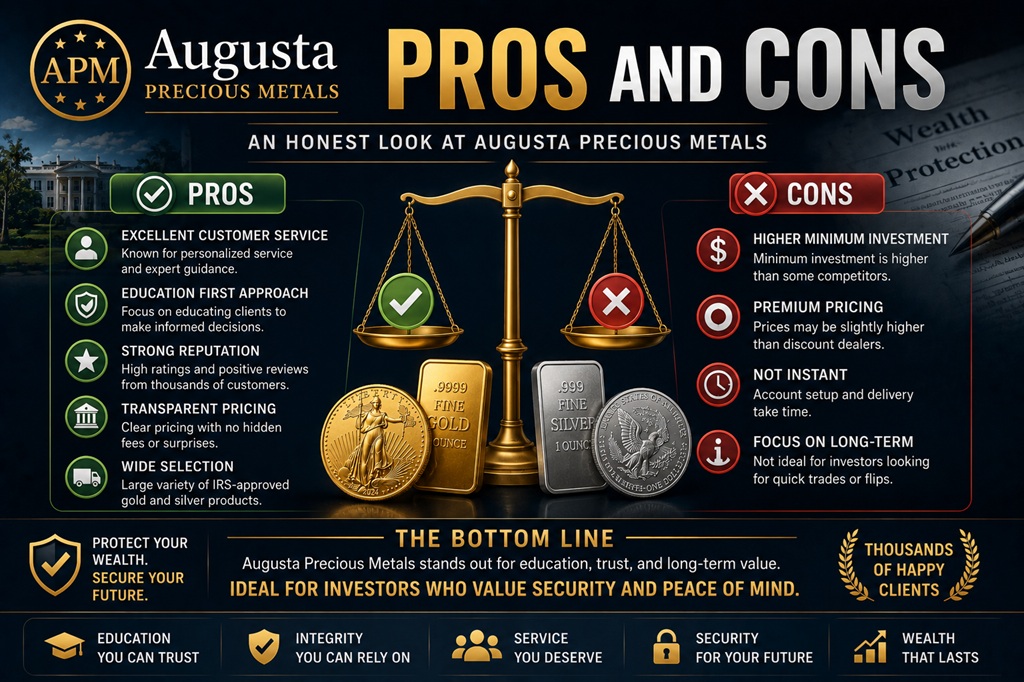
What Are the Pros and Cons of Augusta Precious Metals?
Augusta Precious Metals weighs out as an education-first company with strong third-party standing and one heavy entry limitation. The upside is a salaried, no-pressure onboarding inside a standard IRS tax wrapper, where a gold IRA holds IRS-eligible metal under the same Traditional or Roth tax rules as any IRA. The headline con is a $50,000 minimum, the highest among major gold IRA providers.
This page is the weighing, not the evidence file. Every other page in this cluster proves one slice in depth. This one sets the genuine upsides against the genuine limitations and reaches a measured read on fit. So each pro and each con below is stated as a one-line conclusion, with the numbers, mechanics, and case detail pointed to the page that owns them. The standard-IRA framing rests on the same statute the whole category runs on.
"An IRA can invest in certain gold, silver, and platinum coins as well as gold, silver, palladium, and platinum bullion that meets applicable purity standards, while other collectibles such as art, rugs, antiques, gems, and stamps are not permitted in an IRA," noted Internal Revenue Service Publication 590-A in its guidance on contributions to individual retirement arrangements.
That routing discipline is deliberate. A balanced verdict is only trustworthy if it does not quietly re-argue the rating, the legitimacy case, or the pricing model to pad itself. The full company assessment sits on the
Augusta Precious Metals review, and the pricing-filter mechanics behind the $50,000 figure sit on the
Augusta Precious Metals pricing page. What follows stays on the trade-off itself.
One framing point matters before the tables. A pro and a con are not opposite facts here. They are the same structural choices read from two sides. The education-first model is a pro for a saver who wants to be taught and a non-event for a saver who wants a one-click price. The high minimum is a filter that protects the model and a wall that locks out smaller buyers. Why does that matter for an honest evaluation? Because the question is never "is this good or bad" in the abstract. It is "good or bad for whom," and that is the question this synthesis is built to answer.
Request a Free Guide
What Are the Strongest Augusta Precious Metals Pros?
The strongest upsides are an education-first onboarding, salaried representatives with no per-transaction commission, strong independent third-party standing, a transparent published fee posture, IRS-compliant custody, and the same tax-advantaged wrapper any IRA carries. Each is stated below as a conclusion, with the proof routed to the page that owns it.
Pro one is the salaried, education-first posture, and it carries the most weight. Augusta teaches before it sells, and its people are paid a wage rather than a slice of each ticket, which strips out the urgency that drives a hard close. A reader who wants the documented customer-experience pattern behind that claim should weigh the Augusta Precious Metals review, and the onboarding shape behind it is framed on the
Augusta gold IRA overview. Stated as a verdict line it is short: no closing incentive, so no closing pressure.
Pro two is an ownership chain the buyer does not have to take on faith. By
IRC § 408(m)(3), the metal sits with an independent qualified trustee and a vaulting facility rather than with the seller, which is the structural reason a paid-for position cannot quietly disappear. That single design point is the spine of the whole scam-question answer, and the documented contrast that builds it out is owned by the
is Augusta Precious Metals a scam page. This synthesis states only the conclusion: an independent holder beats a self-held one.
Pro three is the tax shell, again at the verdict level only. The position grows under the ordinary deferral-or-tax-free rules every retirement account uses, so it carries the same shelter a paper account does. One verbatim line frames the eligible-asset boundary that makes any of this lawful.
"An IRA can invest in certain gold, silver, and platinum coins as well as gold, silver, palladium, and platinum bullion that meets applicable purity standards," noted Internal Revenue Service Publication 590-A in its guidance on contributions to individual retirement arrangements.
The bracket math, the contribution ceilings, and the carve-out derivation are not re-run here. They are owned end to end by the
Augusta gold IRA tax benefits page, and this page deliberately stops at the upside conclusion.
Pro four is independent standing. Augusta posts consistent recognition and review results across several outside surfaces, including
Money magazine "Best Overall Gold IRA Company" recognition from 2022 through 2025, stated here only as a one-line strength. Why not list the figures? Because a balanced read that recites every star number is quietly borrowing the ratings page's job to look weightier than a synthesis should. Those figures, and how each scoring system is built, are owned by the
Augusta Precious Metals ratings page.
| Pro |
The Conclusion |
Where the Proof Lives |
| **Education-first model** |
Teaches before it sells, salaried people, no closing incentive |
Augusta Precious Metals review |
| **Strong third-party standing** |
Consistent recognition and reviews across outside surfaces |
Augusta Precious Metals ratings |
| **Independent ownership chain** |
A trustee and a vault, not the seller, hold the position |
is Augusta Precious Metals a scam |
| **Tax shell** |
Same shelter any retirement account carries |
Augusta gold IRA tax benefits |
| **Funding flexibility** |
Most existing workplace or retirement balances can move in |
[Augusta Precious Metals funding methods](/augusta-precious-metals-funding-methods/) |
Pro five rounds the upside out. Most existing workplace-plan or retirement balances can be moved into the structure because the shell is the ordinary one, and the standard required-distribution timing applies exactly as it would on a paper account.
"Section 401(a)(9)(C)(v)(I) provides that in the case of an individual who attains age 72 after December 31, 2022, and age 73 before January 1, 2033, the applicable age is 73," noted Federal Register rulemaking on required minimum distributions.
The path-by-path mechanics of moving that money are owned by the Augusta Precious Metals funding methods page, not weighed again here.
Tax and retirement rules behind a self-directed precious-metals position shift with new legislation, and this weighing reflects only the publication date. Run your own situation past a qualified professional before acting on any upside above.
What Are the Genuine Augusta Precious Metals Cons?
The genuine limitations are a $50,000 minimum, the highest among major providers, no live website pricing, a gold-and-silver-only catalog with no platinum, palladium, or paper assets, and a separate IRS-approved custodian some buyers do not expect. An honest evaluation has to present these plainly rather than soften them.
Con one is the entry gate, and it outweighs the rest. The $50,000 floor is the highest among major providers, and it decides whether a saver gets into the room before any other factor applies. It is the line that turns away the largest slice of would-be buyers. The verdict line is blunt, and the filter math, the fee stack, and the long-term fee waiver behind it are owned in full by the Augusta Precious Metals pricing page, with the price of entry framed on the Augusta gold IRA overview.
Con two is price visibility. Per-product metal numbers are not posted on the public site, so a saver cannot drop a figure into a paper comparison and instead learns it on a consultation call. For someone who wants to shop side by side before talking to anyone, that is genuine friction, and a balanced read counts it rather than waving it off. Why state it as a flat con and stop? Because the quote model and the spread disclosure are the Augusta Precious Metals pricing page's territory, not this one's.
Con three is a narrow shelf. The offering is gold and silver, with no platinum, palladium, mining shares, funds, paper exposure, or home-held arrangement under IRC § 408(m)(3). A saver who wants a wider mix under one roof hits a real ceiling. The enumerated shelf is owned by the Augusta gold IRA overview, so the conclusion is all that belongs here.
| Con |
The Conclusion |
Where the Analysis Lives |
| **Entry gate** |
The highest floor among major providers, the heaviest limitation |
Augusta Precious Metals pricing |
| **Price visibility** |
No posted figure to shop side by side before a call |
Augusta Precious Metals pricing |
| **Narrow shelf** |
Gold and silver only, no wider mix or home-held option |
Augusta gold IRA overview |
| **Second party at setup** |
A trustee enters the picture some savers do not expect |
Augusta Precious Metals complaints |
Con four is a second party the saver may not see coming. A separate qualified trustee, not the seller, holds the account and issues the year-end forms, and a saver expecting one name can be caught off guard even when the structure is entirely sound. It is an expectation gap, not wrongdoing. The point is stated and routed: the recurring-theme breakdown and the representative critical write-up that document it are owned by the Augusta Precious Metals complaints page, and this synthesis does not reproduce that taxonomy.
One precision note keeps the cons honest without overstating them. Augusta's public record carries no formal grievance on its main bureau profile as of the cluster check date, and the friction that does show up reads as setup-expectation mismatch, not deception. That is a point-in-time reading, not a lifetime guarantee, and any line that sells it as a permanent clean slate claims more than one profile can support. Why frame the cons this carefully? Because a balanced page that hides limitations is not balanced, and one that inflates them is not accurate. The volume-and-platform breakdown behind that nuance is owned by the Augusta Precious Metals complaints page.
This weighing is a snapshot, not legal or tax advice. Run any single limitation here past your own qualified professional before it drives a decision.
Request a Free Guide
Is the $50,000 Augusta Minimum Worth It?
Whether the $50,000 minimum is worth it depends entirely on the saver. For someone already moving a five-figure-plus retirement balance who values an education-first, no-pressure process, the floor is a reasonable trade. For an entry-level saver below the threshold, it is not, and that is a category-level fit question rather than a knock on anyone.
This is the analysis no other page in the cluster runs. The pricing page owns how the minimum functions as a filter. This page owns whether that filter is worth clearing. Those are different questions, and the second one is a judgment, not a mechanism.
Start with what the floor actually buys. A five-figure minimum lets Augusta run a salaried, education-first model with a dedicated agent who stays with the account, because the customer base is filtered to savers with a meaningful balance to move. It also pairs with a fixed published fee posture rather than a percentage-of-assets drag that scales with the balance over a multi-decade hold. For a larger, long-horizon position, a fixed annual cost can matter more than the entry gate itself. The fee-stack line items that sit behind that point are owned by the Augusta Precious Metals pricing page, and the cost of entry is framed on the Augusta gold IRA overview.
Now weigh what it costs. The floor locks out every saver below it, full stop. It also pairs with no homepage price, so a buyer cannot even size the metal cost before clearing the gate and taking the call. For a smaller or first-time position, those two costs together are decisive, and no amount of model quality offsets a wall a buyer cannot get over. The honest read is that the minimum is not universally worth it. It is worth it for one specific saver and plainly not worth it for another.
So how should a reader actually use this? Match the floor to the balance and the temperament, not to the brand. A saver rolling a sizeable 401(k) who wants to be taught before deciding gets real value for the price of entry. A saver with a few thousand dollars to start gets a closed door and should read that as routing information, not rejection. Why frame it that way rather than as a simple verdict? Because a five-figure gate is the single most decision-relevant fact on this page, and pretending it has one answer for everyone would be the least honest thing this evaluation could do.
Individual circumstances vary. Consult a licensed financial advisor, tax professional, or attorney before committing a five-figure balance based on the information in this section.
Request a Free Guide
Who Is Augusta Precious Metals Right For?
Augusta fits a pre-retiree or retiree with a sizeable existing 401(k) or IRA balance who wants an education-first, no-pressure process and is comfortable with a phone-quoted price and a gold-and-silver-only catalog. The fit is narrow by design, and that is the point of a synthesis page rather than a flaw in it.
Match dimension one is balance and tempo. The strong match is a saver who already sits above the $50,000 floor with money to reposition, who wants the mechanics explained before committing, and who is fine learning the price on a call. For that person the pros stack and the cons mostly miss, because the gate is behind them and the phone quote reads as care rather than evasion. This page weighs that match and points the underlying how-it-works picture to the Augusta gold IRA overview rather than rebuilding it.
Match dimension two is the tax and wrapper picture. A saver pointed toward a pre-tax or after-tax shell, or a business owner weighing an employer-funded one, can hold the same metal inside whichever shell suits, because the shelter is the ordinary retirement one. Which shell suits whom is a judgment this synthesis does not make. The shell-by-shell breakdown is owned by the Augusta Precious Metals account types page and the bracket math by the Augusta gold IRA tax benefits page.
Match dimension three is where the money starts. The natural match already holds a workplace-plan or retirement balance to move, since funding purely from fresh yearly contributions would take many years to top the floor. That makes the existing-balance saver the obvious one. The path comparison that turns this into action is owned by the Augusta Precious Metals funding methods page, not weighed again here.
What binds the match is disposition, not just account size. The strong match treats a retirement move as something to study, reads a wage-paid representative as reassurance, and is content weighing two metals without wanting a broader basket in the same place. A small group? A defined one, and a defined match is more honest than a claim that one provider suits everyone. The standing evidence behind that disposition is owned by the Augusta Precious Metals review.
IRS rules governing self-directed IRAs and account-type eligibility are complex and change with new legislation. Confirm the current treatment for your situation with a tax professional or IRS-approved custodian before acting on any fit point above.
Request a Free Guide
Who Should Look Elsewhere Instead?
A saver below the $50,000 threshold, a buyer who wants platinum or palladium or paper-asset exposure, a self-directed buyer who insists on a published online price, and a buyer who wants same-day account opening are each better served by a different category option. Naming the mismatch honestly is part of a balanced evaluation.
The clearest mismatch is the entry gate. A saver with a few thousand dollars to start cannot clear a $50,000 minimum, and no model quality changes that arithmetic. That buyer should look at a different category option with a lower floor rather than treat the wall as a verdict on their plan. The pricing-filter detail behind the gate is owned by the Augusta Precious Metals pricing page.
The second mismatch is product scope. A buyer who wants platinum or palladium, mining-stock exposure, a precious-metals ETF allocation, or paper gold inside one provider will not find it here, because Augusta offers IRS-eligible gold and silver only under IRC § 408(m)(3) metal-type limits. That is a structural fit problem, not a defect, and the buyer who needs the wider mix should weigh a provider built for it. The full catalog detail is owned by the Augusta gold IRA overview.
The third mismatch is the pricing format. A self-directed buyer who insists on a published online price and refuses to take a consultation call to learn it will find the phone-quote model a poor fit, even though the model itself is defensible. The quote mechanism and the ask-to-bid disclosure are owned by the Augusta Precious Metals pricing page. The fourth mismatch is tempo. A buyer who wants same-day account opening will find an education-first sequence built the other way, and that buyer is a better fit elsewhere by design.
Note what this section deliberately does not do. It does not name a rival or steer the reader to one, because category-level critique is more useful and more honest than a comparison built to favor anyone. Recurring Federal Trade Commission documented red-flag patterns in the retail precious-metals industry include failure to disclose fees before payment and high-pressure telemarketing, and these are documented industry patterns rather than findings against Augusta. The right move for a mismatched buyer is to apply that category screen to whatever option they consider next. Why frame it as routing rather than rejection? Because "not for you" is not "not legitimate," and conflating the two would be the least accurate thing this page could say.
Individual circumstances vary. Consult a licensed financial advisor, tax professional, or attorney before ruling Augusta in or out based on the information in this section.
What Is the Honest Verdict on Augusta Precious Metals?
The measured verdict is that Augusta is a strong fit for its intended saver and a poor fit outside that profile. Its upsides are structural and consistent. The limitations are real and disclosed rather than hidden, and a gold IRA still carries the same Traditional or Roth tax wrapper any IRA does. What decides the call is whether the saver matches the profile, not whether the company is good in the abstract.
Weigh the two tables one last time. On the pro side sit an education-first salaried model, strong independent standing, IRS-compliant custody, a standard tax-advantaged wrapper, and funding flexibility. On the con side sit a $50,000 minimum, no live website pricing, a gold-and-silver-only catalog, and a separate custodian some buyers do not expect. Those pros are mostly structural strengths that hold across savers. The cons, by contrast, are mostly fit filters that bite some savers hard and others not at all. That asymmetry is the verdict in one line: a high-quality model with a narrow door.
This page deliberately does not assign a numeric score. A single rating is the Augusta Precious Metals review page's job, and re-scoring here would duplicate it. What this synthesis adds instead is the weighing logic behind any score, which is the part a reader actually needs to make the call for their own situation. The legitimacy question that sometimes sits behind a pros-and-cons search has its own answer too. No federal enforcement action, FTC complaint, or US Tax Court matter naming Augusta surfaced in available public records as of the cluster access date, stated here only as a reassurance conclusion against the category fraud baseline. The full records analysis is owned by the is Augusta Precious Metals a scam page and the broader is Augusta Precious Metals legit page.
So what should a reader do with this verdict? Match the profile honestly. If the balance clears the floor and the temperament fits an education-first process, the weighing comes out strongly positive and the supporting evidence is one click away on each owner page. If the profile does not match, the weighing comes out negative for a structural reason, and that is useful information rather than a failing grade. The rating numbers that sit behind the standing claim are owned by the Augusta Precious Metals ratings page. Always consult your own legal, financial, and tax professionals before opening or funding a gold IRA.
Request a Free Guide
Frequently Asked Questions
What are the pros and cons of Augusta Precious Metals?
The main pros are an education-first onboarding, salaried representatives with no per-transaction commission, strong independent third-party standing, IRS-compliant custody, a standard tax-advantaged wrapper that follows the same Traditional or Roth rules as any IRA, and funding flexibility. The main cons are a $50,000 minimum, the highest among major providers, no live website pricing, a gold-and-silver-only catalog, and a separate IRS-approved custodian some buyers do not expect. The supporting evidence for each point is covered on the Augusta Precious Metals review and the Augusta Precious Metals pricing page.
What is the biggest downside of Augusta Precious Metals?
The biggest downside is the $50,000 minimum to open a precious-metals IRA, which is the highest minimum among major gold IRA providers. That single figure disqualifies the largest share of prospective buyers before any other factor matters. It is a deliberate positioning decision rather than a fee, but it is a real barrier for smaller or first-time savers. The pricing-filter mechanics and the published fee stack behind the figure are covered in full on the Augusta Precious Metals pricing page.
Is Augusta Precious Metals worth it?
It depends on the saver. For a pre-retiree or retiree already moving a five-figure-plus balance who values an education-first, no-pressure process, the weighing comes out strongly positive. For a saver below the $50,000 threshold or one who wants a wider metal mix, it does not, because the entry gate and the narrow catalog are decisive for that profile. There is no single yes-or-no answer, which is why the full assessment is covered on the Augusta Precious Metals review.
Who is Augusta Precious Metals best for?
Augusta is best for a pre-retiree or retiree with a sizeable existing 401(k) or IRA balance who wants an education-first process and is comfortable with a phone-quoted price and a gold-and-silver-only catalog. The fit is narrow by design and turns on balance size, tax picture, and temperament rather than on the company being universally suitable. The structural detail behind that fit is covered on the Augusta gold IRA overview and the Augusta Precious Metals account types page.
Does Augusta have any real complaints or downsides?
Yes. The genuine limitations are the $50,000 minimum, no live website pricing, a gold-and-silver-only catalog, and a separate IRS-approved custodian some buyers do not expect. No formal
Better Business Bureau complaints currently appear on Augusta's profile as of the cluster access date, and the recurring critical themes that do surface are structural expectation gaps rather than fraud. That is a snapshot rather than a categorical guarantee, and the full complaint-volume analysis is covered on the Augusta Precious Metals complaints page.
Is Augusta Precious Metals a legitimate company despite the high minimum?
Yes. A high minimum is a positioning decision, not a legitimacy signal. No federal enforcement action, FTC complaint, or US Tax Court matter naming Augusta surfaced in available public records as of the cluster access date, read against the category's documented fraud baseline. The records finding and the structural rebuttal are covered on the is Augusta Precious Metals a scam page, and the broader legitimacy verification is covered on the is Augusta Precious Metals legit page.
Risk Warning: Precious metals investments carry risk, including the possible loss of principal. Gold and silver prices can fluctuate based on macroeconomic conditions, currency movements, and market sentiment. Past performance is not a guarantee of future results, and historical context is illustrative only. A gold IRA is a long-term diversification tool, not a short-term trading vehicle. IRS rules governing self-directed IRAs are complex and change with new legislation. Always consult your own licensed legal, financial, and tax professionals before opening or funding a gold IRA.
About the Editorial Team
Augusta Precious Metals Reviews is the editorial site covering Augusta Precious Metals. We publish articles about Augusta's products, leadership, fees, customer experience, and gold IRA structure under an editorial team byline. Our coverage cites named third-party authorities (Internal Revenue Service, Cornell Legal Information Institute, Federal Register, Federal Trade Commission) and Augusta's own published positioning. We do not publish urgent, scarcity-driven, or high-pressure content. Editorial review process is documented on the About page.
Disclosure: This site has a partnership relationship with Augusta Precious Metals and may earn a commission from accounts opened through the contact methods on this site, in line with [Federal Trade Commission](https://www.ftc.gov/) affiliate-disclosure rules under 16 CFR Part 255. Editorial coverage reflects Augusta's published positioning and the current IRS rules governing self-directed precious-metals IRAs.
Weighing Augusta against the alternatives? Our Augusta vs Goldco vs American Hartford Gold breakdown puts the three side by side.
Disclaimer: This article is for informational purposes only and does not constitute financial, tax, or legal advice. Augusta Precious Metals Reviews is not a licensed financial advisor, CPA, or attorney. Consult a qualified professional before making investment or tax decisions.