How to Evaluate a Gold IRA Company: Step-by-Step Guide
TL;DR: A gold IRA is a legitimate, IRS-recognized structure under IRC 408(m). The risk sits with the company, not the structure. This guide covers six checks, custodian, storage, fees and spread, buyback terms, ratings, and enforcement history, that take about 30 minutes to run on any dealer before you fund an account.
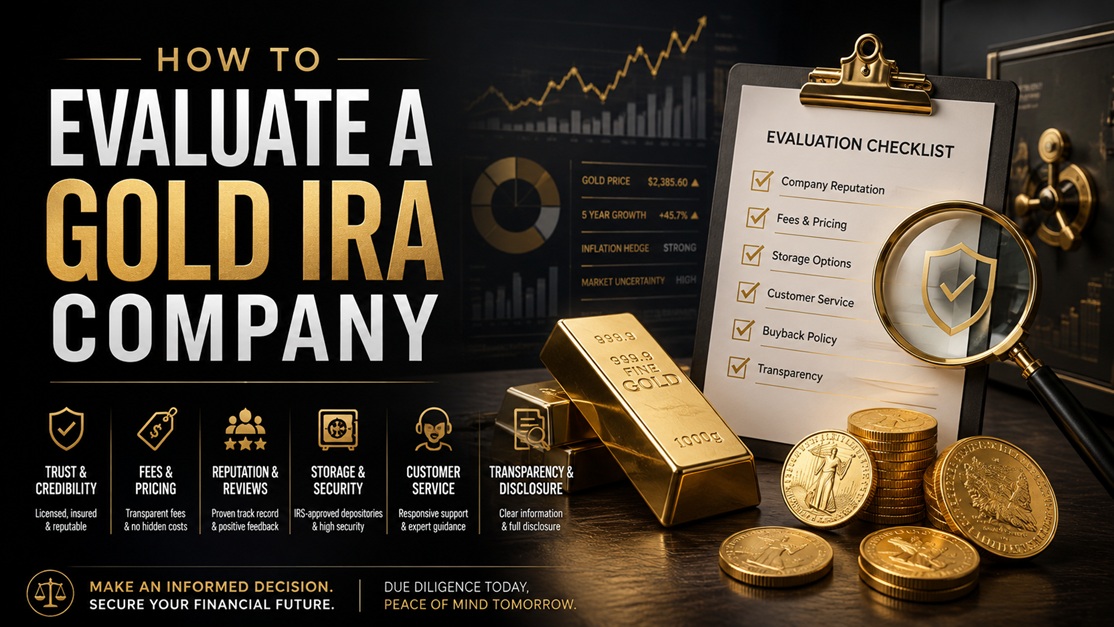 Is a gold IRA legit? The account type is a legitimate, IRS-recognized retirement structure. IRC 408(m)(3) carves specific precious metals out of the general IRA collectibles ban, putting a gold IRA on the same legal footing as a traditional or Roth IRA holding stocks and mutual funds. What varies from one dealer to the next is markups, storage terms, and buyback policies, and that's where the real risk lives. This guide breaks vetting into six checks: custodian, storage, the fee stack and spread, buyback terms, ratings, and enforcement history. Run all six on any gold IRA company you're considering, Augusta Precious Metals included, before you move a dollar.
Is a gold IRA legit? The account type is a legitimate, IRS-recognized retirement structure. IRC 408(m)(3) carves specific precious metals out of the general IRA collectibles ban, putting a gold IRA on the same legal footing as a traditional or Roth IRA holding stocks and mutual funds. What varies from one dealer to the next is markups, storage terms, and buyback policies, and that's where the real risk lives. This guide breaks vetting into six checks: custodian, storage, the fee stack and spread, buyback terms, ratings, and enforcement history. Run all six on any gold IRA company you're considering, Augusta Precious Metals included, before you move a dollar.
What You Need Before You Start
Decide which companies you're comparing before you call anyone, and settle on what you'd realistically buy first. The framework works fastest run side by side on two or three candidates, since comparison itself often reveals a problem a single call would miss. Time required: 20 to 30 minutes per candidate company, longer if you're comparing several. Difficulty: Easy. Every question here works by phone or email. No financial background required. You'll want the following on hand.- A short list of the gold IRA companies you're considering, ideally two or three
- A notepad or document to record each company's answers side by side
- The exact coin or bar you'd realistically buy first, for an apples-to-apples quote
- Login access to at least two ratings platforms, such as the Better Business Bureau, Trustpilot, ConsumerAffairs, or the Business Consumer Alliance
Step 1: Verify the Custodian and Trustee
Ask for the name of the IRA custodian in writing before you discuss any product. Federal law requires that IRA assets sit with a bank or an IRS-approved nonbank trustee, never with the account owner directly, so a company that can't or won't name its custodian is describing a structure the IRS doesn't recognize. Why this matters: this single question filters out most bad actors before you spend another minute on the call. An IRS-approved nonbank trustee has to demonstrate fiduciary ability, capacity to account for assets, adequate net worth, and continuity of operation under 26 CFR 1.408-2(e), the regulation issued under IRC 408(a)(2) and 408(n). That's why most gold IRA dealers work with an established trust company rather than acting as trustee themselves. Confirm the custodian's name independently rather than taking the dealer's word for it. Watch out for: any pitch built around "checkbook control" or a self-directed LLC that would make you, not an approved trustee, the one holding the metal. A pitch describing a way to skip the custodian is describing a structure the IRS doesn't recognize, whatever the paperwork calls it.Step 2: Confirm How and Where the Metal Is Stored
Ask which depository holds the metal, by name, and whether storage is segregated or commingled. IRC 408(m)(3) requires that eligible bullion and coins sit in the physical possession of a qualified trustee, a rule that closes the door on any arrangement letting you keep coins at home while claiming IRA tax treatment. Why this matters: storage is where the "home storage gold IRA" pitch tries to slip past the rules. In McNulty v. Commissioner, the Tax Court ruled in 2021 that an account owner who took physical possession of IRA-owned coins through a self-directed LLC had triggered a taxable distribution, not a legitimate storage arrangement. Ask whether your bars and coins would be segregated or commingled with other customers' matching product, and what each option costs. Neither answer is wrong. Both are compliant, but the price difference should be disclosed, not buried. Watch out for: any variation of "home storage IRA," "checkbook IRA for gold," or a promoter who tells you an LLC structure lets you hold the coins yourself. Our breakdown of the home storage gold IRA myth covers why that pitch fails in more detail.Step 3: Get the Fee Stack and Spread in Writing
Request the full fee schedule, setup, annual custodian, and annual storage, plus the metal spread on a specific coin, in writing, before you fund anything. The spread, not the account fees, is usually where the real cost of a gold IRA hides. Why this matters: account fees are easy to compare. The spread is the number most dealers would rather discuss by phone than put in an email. Bullion premiums run roughly 5 to 10 percent over spot, and numismatic coin premiums run 40 to 200 percent, according to the Commodity Futures Trading Commission's customer advisory on precious metals. That range is your benchmark. Ask for the spread on a plain bullion coin and, separately, on any premium coin recommended, then compare both figures to the CFTC's range. A dealer who quotes fees readily but won't name a spread on a specific product is answering only half the question. Watch out for: "free silver" promotions and other bundled incentives. They're rarely free. The cost usually shows up as a wider spread on the metal you do buy. Our page on how Augusta's pricing works is one example of a dealer disclosing both fee lines and its quote process in writing.Step 4: Read the Buyback Terms Before You Buy
Ask whether the company guarantees buybacks and, if not, how it sets the buyback price. Most reputable dealers stop short of an unconditional guarantee, since metal prices move daily, but the general pricing basis should still be something you can get in writing. Why this matters: a buyback that exists only as a verbal assurance isn't a policy. It's a sales point. A sale works one of two ways. The custodian either sells the metal for a cash distribution, sending you the proceeds, or ships you the physical metal as an in-kind distribution, a taxable event at fair market value in a traditional IRA. Either way, the dealer quotes a buyback, or bid, price, typically below the retail, or ask, price, the same spread from Step 3 working in reverse. Ask what basis sets that bid price and roughly how long settlement takes. Watch out for: a dealer who won't describe the buyback process until after you've bought. Get the general terms, pricing basis, and rough timeline before you fund the account. Would you sign a purchase agreement with the exit terms left blank? A buyback policy is the exit terms.Step 5: Cross-Check Ratings Across Multiple Platforms
Pull the company's standing on at least three review platforms, typically the Better Business Bureau, the Business Consumer Alliance, Trustpilot, and ConsumerAffairs, rather than trusting whichever badge sits on the company's own homepage. A single glowing average hides more than it reveals if you don't also check how the complaints read. Why this matters: different platforms measure different things, and a company can look different depending on which one you check. The Better Business Bureau's own published ratings methodology states plainly that customer reviews aren't part of the letter-grade calculation, so an A+ rating and a strong review average are measuring two separate things, not confirming each other, according to the Bureau's own site. Cross-reference at least one more platform, note the total review count, and read the one-star reviews for the nature of the complaint. A shipping delay reads very differently than an allegation about undisclosed markups. Watch out for: treating a single top-grade badge as the whole verification job. It's one data point among four or five worth checking.Step 6: Screen for Red Flags and Enforcement History
Search the company's name, and its principals' names, against SEC and CFTC enforcement records before you call, and learn what a documented scheme looks like so you can recognize the same pattern on a sales call. Why this matters: real enforcement cases show exactly how the gap between the marketed price and the actual price opens up. On May 15, 2023, the SEC's own announcement described a scheme in which Red Rock Secured, later rebranded as American Coin Co, told customers to expect a 1 to 5 percent markup while actually charging as much as 130 percent, pocketing more than $30 million of the more than $50 million it collected. A related CFTC judgment found the same defendants had convinced at least 950 people to pay over $69 million for coins worth only $30 million. Neither case involved a secret scheme. Both ran on customers who never got a written quote before they wired money, exactly what Steps 3 and 4 force into the open. Watch out for: high-pressure, same-day-close scripts and any pitch built around a fear timeline. Neither is illegal on its own. Both work against a careful decision.How Augusta Precious Metals Maps Onto This Framework
Running this framework against Augusta Precious Metals works as a useful worked example, because the company publishes most of the answers rather than requiring a phone call to get them. Augusta names Equity Trust Company as its primary custodian and the Delaware Depository as its primary storage partner, publishes an itemized fee schedule of $50 setup, $125 annual custodian, and $100 annual storage, and carries active accreditation across the platforms this framework asks you to check. That disclosure doesn't exempt Augusta, or any company, from the six checks. For the full walk-through, current ratings included, see our Augusta Precious Metals review. The deeper legitimacy-specific write-up lives at Is Augusta Precious Metals Legit?, which applies this same scrutiny directly to Augusta.Common Mistakes to Avoid
First-time buyers tend to trip on the same handful of mistakes, each one avoidable with the checks above.- Assuming the dealer is the custodian. A gold IRA company sells metal, but a separate, IRS-approved custodian holds the account. Confusing the two means you never ask who the trustee is.
- Accepting a price quote without the spread in writing. A dealer can quote the fee schedule accurately and still make most of its margin on an undisclosed markup over spot.
- Treating one ratings platform as the full picture. A strong Trustpilot score and a thin Better Business Bureau complaint history can coexist with a different picture on ConsumerAffairs or the Business Consumer Alliance.
- Skipping the enforcement search because the company "seems established." Some of the largest precious-metals fraud judgments involved companies that had operated for years with favorable reviews right up until the case was filed.
What to Expect After Completing These Steps
Running all six checks on two or three candidates typically takes 60 to 90 minutes, most spent on hold or waiting on a written quote by email. That's a small cost against a decision worth tens of thousands of dollars. By the end you should have a named custodian and depository in writing, an itemized fee schedule, a same-day quote you can compare across dealers, a buyback policy you can read rather than take on faith, a cross-platform ratings picture, and a clean or flagged enforcement search. If a company can't produce one of these on request, that's usually the answer. Why give the benefit of the doubt on the other five items after a company fails the first one?Frequently Asked Questions
Is a Gold IRA Legit?
Yes. A gold IRA is a self-directed IRA authorized under IRC 408(m)(3), the same statute that carves gold, silver, platinum, and palladium bullion and coins out of the general IRA collectibles ban, with the same tax treatment and IRS oversight as a traditional or Roth IRA. What isn't guaranteed by the structure is the company you use to set one up, which is why the framework above exists.How Do You Choose a Gold IRA Company?
Run the same six checks on every company you're considering. Confirm the custodian and depository by name, get the fee schedule and spread in writing, read the buyback policy, check ratings across at least three platforms, and search SEC and CFTC enforcement history. A company willing to put those answers in writing has cleared the most important test.What's the Biggest Red Flag When Evaluating a Gold IRA Company?
Refusing to put numbers in writing before you commit money, covering the fee schedule, the spread on a specific coin, and the buyback policy. Documented federal cases show the pattern: a verbal promise of a small markup, followed by an actual charge many times higher once the money moves. A representative who resists a written quote or pushes for a same-day decision is sending the loudest signal in the framework.Do I Need to Check More Than One Ratings Platform?
Yes. The Better Business Bureau, the Business Consumer Alliance, Trustpilot, and ConsumerAffairs each run independent review systems, and a company's standing can look different on each. Its own methodology states that customer reviews aren't part of the letter-grade calculation, so a top rating and a strong review average measure two different things.Is a Gold IRA Legitimate if the Company Has a Perfect Online Rating?
A high rating is a good sign, not a finished verification. Review platforms score customer experience and complaint resolution, not markup size or regulatory history. A company can carry a strong rating and still charge markups above the CFTC's benchmark range for bullion, so treat ratings as one check, not a substitute for the rest.Risk Warning: Precious metals investments carry risk, including the possible loss of principal. Gold and silver prices fluctuate based on macroeconomic conditions, currency movements, and market sentiment. Past performance is not a guarantee of future results. A gold IRA is a long-term diversification tool, not a short-term trading vehicle. IRS rules governing self-directed retirement accounts and dealer practices are complex and vary by company. Always consult your own licensed legal, financial, and tax professionals before opening or funding a gold IRA.About the Editorial Team Augusta Precious Metals Reviews is the editorial site covering Augusta Precious Metals. We publish articles about Augusta's products, leadership, fees, customer experience, and gold IRA process under an editorial team byline. Our coverage cites named third-party authorities, including federal tax law, the Securities and Exchange Commission, and the Commodity Futures Trading Commission, alongside Augusta's own published positioning. We do not publish urgent, scarcity-driven, or high-pressure content. We close every educational article with a soft reminder to speak with your own legal, financial, and tax professionals before investing. Disclosure: This site has a partnership relationship with Augusta Precious Metals and may earn a commission from accounts opened through the contact methods on this site, in line with Federal Trade Commission affiliate-disclosure rules under 16 CFR Part 255. This article presents a general evaluation framework that applies to any gold IRA company, Augusta included.
Once you've vetted a company, our setup checklist covers the paperwork.
Disclaimer: This article is for informational purposes only and does not constitute financial, tax, or legal advice. Consult a qualified professional before making investment decisions.