Augusta Segregated vs Commingled Storage: Which Option Fits Your Gold IRA?
TL;DR: Augusta Precious Metals stores gold IRA metal in a shared, commingled vault by default, not in a segregated one. Augusta's own published fee schedule lists a $100 annual charge for non-segregated storage as the standard rate, and that line item is the clearest proof the default arrangement is commingled rather than segregated. Segregated storage exists as a paid upgrade, but Augusta does not publish a flat price for it, so a saver who wants that option has to confirm the cost directly with a dedicated agent. Both arrangements sit inside the same IRS-approved Delaware Depository, insured under Lloyd's of London, and both satisfy the third-party custody rule that keeps a gold IRA tax-advantaged. This guide compares the two storage types side by side and walks through which one actually fits your account.
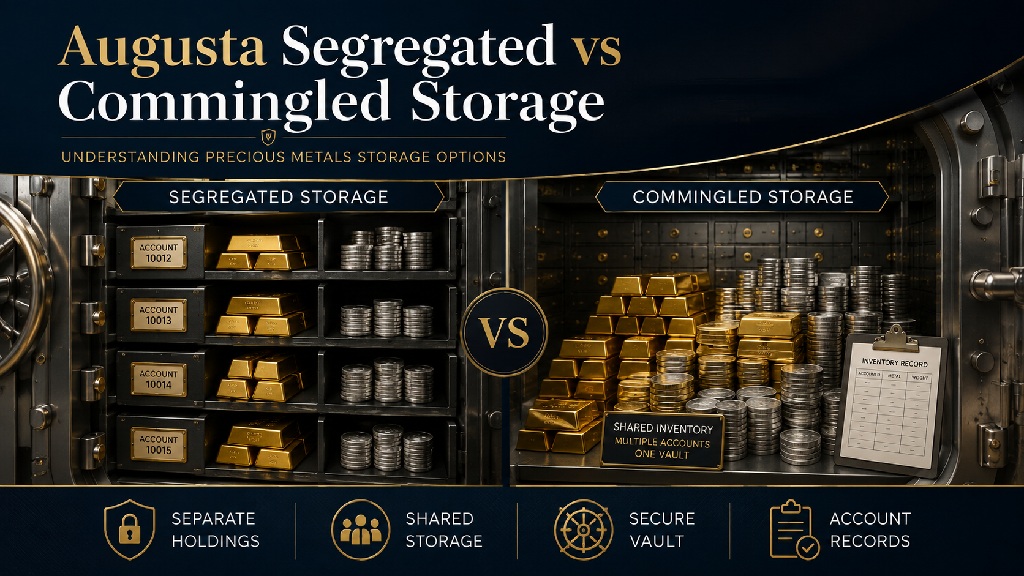
Segregated and commingled are the two ways a gold IRA custodian can vault your metal, and the difference comes down to whether your specific bars and coins sit apart from everyone else's or alongside them. Commingled storage means your holding is tracked to your account by record while it shares vault space with other customers' matching product. Segregated storage means your exact bars and coins are physically set apart and labeled to your account alone. Augusta Precious Metals defaults every new account to commingled storage, confirmed by a $100 annual non-segregated storage charge on its published fee schedule, and segregated storage sits on top of that as an upgrade rather than the standard path. Money magazine named Augusta its Best Overall Gold IRA Company across four straight years from 2022 through 2025, a recognition that runs alongside the same education-first approach Augusta brings to storage and custody questions. The full Augusta gold IRA overview covers the broader account structure this comparison sits inside.
Commingled storage, sometimes called non-segregated storage or allocated-by-record storage, means your gold or silver sits in the same vault space as other customers' matching product while the depository and custodian track ownership through account records rather than physical separation. Segregated storage, sometimes called allocated storage or separate storage, means the specific bars and coins bought for your account are physically set apart and labeled so no other customer's holding touches yours inside the vault.
Neither term describes a security level on its own. Both options place your metal inside the same insured, IRS-approved facility, and both list your holding on custodian statements under your name and account number. The real difference is closer to how a library tracks two copies of the same book. A commingled shelf holds every copy together and checks out whichever copy is nearest, while a segregated shelf assigns one specific copy to one specific reader and never swaps it for another.
That distinction matters because gold and silver bullion is fungible within a given product line. A one-ounce American Gold Eagle from one customer's purchase is functionally identical to any other one-ounce American Gold Eagle in the same vault, so tracking commingled ownership by record works the same way tracking shares of a company's stock works. Segregated storage exists for savers who still want that specific physical separation regardless of the fungibility argument, and Augusta offers both paths, just not at the same default cost.
Commingled. Augusta Precious Metals bills every new account the $100 annual non-segregated storage fee unless a saver specifically requests and pays for the segregated upgrade instead. That published charge is the single clearest piece of evidence available, since a company does not publish a standard fee for an arrangement it treats as an exception.
Augusta's default is commingled storage, not segregated storage.
Some marketing language across the gold IRA industry blurs this point, occasionally implying that a premium provider automatically separates a customer's metal. That is not how Augusta Precious Metals prices its own accounts, and confusing the two is the single most common mistake a first-time buyer makes when comparing storage terms. The $100 rate covers commingled storage specifically, according to Augusta Precious Metals' own fee disclosure, and a saver who assumes that fee buys physical separation is working from the wrong assumption before the account even funds.
Why would a company default to the cheaper, shared arrangement instead of the one that sounds more exclusive? Cost efficiency drives that choice across the industry generally, since segregated storage requires the depository to carve out and maintain dedicated space for every account instead of pooling like products together. Commingled pricing passes that efficiency on to the customer as a lower standard fee, and segregated pricing reflects the extra handling the depository takes on to keep one account's bars and coins apart from every other account.
Yes. Segregated storage is available through Augusta as a paid upgrade for savers who want their exact bars and coins physically set apart, and requesting it does not require switching custodians or dealers.
The exact upgrade cost depends on account size and metal mix, and Augusta does not publish that figure as a flat rate the way it publishes the $100 non-segregated charge. A dedicated agent quotes the segregated price directly once account details are on the table, since the depository's own handling cost scales with how much metal a given account holds. Confirm the segregated storage option and its cost directly with Augusta before assuming any specific number, because no public source, including this one, currently lists a fixed segregated rate.
A saver considering the upgrade should raise it early, ideally during the same conversation that covers account minimums and metal selection. That timing matters because segregated storage is easier to set up before a first purchase clears than to convert into after commingled metal is already sitting in the vault, even though a later conversion is still possible through the same dedicated agent relationship.
Yes, both are equally compliant. IRC 408(m)(3) requires a qualified trustee to hold gold IRA bullion, and both commingled and segregated arrangements satisfy that requirement because both keep the metal inside a third-party depository rather than in the account holder's possession.
Neither storage type is a form of home storage, and that distinction carries real financial weight. In McNulty v. Commissioner, the Tax Court ruled in 2021 that an IRA owner who had coins shipped to a personal safe through an IRA-owned LLC had received a taxable distribution, closing a marketing loophole that predated the case. Commingled and segregated storage both avoid that problem entirely, since Augusta ships every IRA purchase straight to the depository and never to a customer's address. The home storage myth still circulates in gold IRA marketing years after that ruling, and choosing between commingled and segregated does not reopen that door either way.
Does the depository track a commingled holding any less carefully than a segregated one? No. The custodian's account statements list the exact holding under the account holder's name whether the metal sits in shared or separated vault space, and Form 5498 reports contributions and rollovers the same way regardless of which storage type the account uses. The paperwork trail is identical. Only the physical vault arrangement differs.
The published $100 storage rate pays the Delaware Depository for vault space, insurance coverage, and the recordkeeping that ties a specific holding to a specific account, and that figure applies to the commingled arrangement Augusta treats as its default.
That storage charge is one piece of a larger cost structure. Augusta's published stack combines a $50 one-time account setup charge, a $125 yearly custodian administration fee, and the $100 yearly non-segregated storage charge, adding up to $275 due in an account's opening year and $225 due in every year after that. Consumer Affairs corroborates that same fee structure on its own Augusta profile, and the storage line specifically covers non-segregated custody rather than a segregated rate. A full breakdown of how those charges interact with the metal spread quoted during Augusta's onboarding call lives on the Augusta Precious Metals pricing page elsewhere on this site.
Does choosing segregated storage change the other two fees? No, only the storage line moves. The $50 setup charge and $125 custodian fee stay the same regardless of which storage type an account uses, since those cover account administration rather than vault handling. Only the storage figure itself shifts once a saver requests the segregated upgrade, and that shift is exactly the number a dedicated agent has to quote directly, according to Consumer Affairs' broader reporting on Augusta's fee transparency.
Which Storage Option Should You Choose?
Most Augusta customers never have to make an active choice, since commingled storage applies automatically unless a saver requests the segregated upgrade. The table below breaks down what each option actually is, who tends to prefer it, and how the cost basis compares.
| Factor | Commingled (Non-Segregated) | Segregated (Allocated) |
| What it is | Metal pooled with other customers' matching product, tracked by account record | A specific customer's bars and coins physically set apart and labeled |
| Who it suits | Most bullion holders buying standard coins and bars for long-term retirement savings | Savers who want their exact pieces set aside regardless of extra cost |
| Cost basis | $100 per year, Augusta's published default storage rate | Priced individually by a dedicated agent, confirm directly with Augusta |
A saver funding a standard American Gold Eagle or American Silver Eagle position rarely gains a practical benefit from segregated storage, since one coin is functionally identical to any other coin of the same type and year. Segregated storage tends to appeal more to savers who hold larger positions, want the psychological reassurance of a physically separated holding, or plan to visit or verify a specific set of pieces down the road. Neither choice changes the tax treatment of the account or the paperwork a saver receives every spring.
Frequently Asked Questions
Does Augusta Store Gold IRA Metal as Segregated by Default?
No. Augusta's default storage arrangement is commingled, not segregated. The company's published fee schedule lists a $100 annual charge specifically for non-segregated storage as the standard rate every new account pays unless the saver requests and pays for the segregated upgrade instead. A saver who assumes segregated storage is the default before confirming with Augusta is working from an incorrect assumption that can affect both the cost and the vault arrangement of the account.
What Does Non-Segregated Storage Mean for an Augusta Gold IRA?
Non-segregated storage, also called commingled storage, means an account's gold or silver shares vault space with other customers' matching product while custodian and depository records track ownership back to the specific account. The metal still sits inside an IRS-approved depository under the account holder's name, and it still appears on custodian statements the same way a segregated holding would. Only the physical placement inside the vault differs, not the ownership record or the tax treatment.
How Much Does Augusta Charge for Segregated Storage?
Augusta has not published a flat segregated storage rate. The commingled default costs $100 per year, but the segregated upgrade price depends on account size and metal mix, and a dedicated agent quotes that figure directly once account details are known. Confirm the segregated storage option and its cost with Augusta before committing to that upgrade, since no fixed public number currently exists to reference.
Is Commingled Storage Less Secure Than Segregated Storage?
No. Both storage types sit inside the same insured, IRS-approved Delaware Depository, and both satisfy the third-party custody requirement under IRC 408(m)(3) that keeps a gold IRA tax-advantaged. Commingled storage tracks ownership through account records instead of physical separation, but that recordkeeping carries the same legal weight as a segregated arrangement. The choice between the two affects vault placement and cost, not the underlying security of the holding.
Risk Warning: Precious metals investments carry risk, including the possible loss of principal. Gold and silver prices can fluctuate based on macroeconomic conditions, currency movements, and market sentiment. Past performance is not a guarantee of future results. Storage arrangements, custodian relationships, and depository partners can change over time, so confirm current details directly with Augusta before opening or funding an account. IRS rules governing self-directed retirement accounts and storage requirements are complex and subject to change. Always consult your own licensed legal, financial, and tax professionals before opening or funding a gold IRA.
About the Editorial Team
Augusta Precious Metals Reviews is the editorial site covering Augusta Precious Metals. We publish articles about Augusta's products, leadership, fees, customer experience, and gold IRA process under an editorial team byline. Our coverage cites named third-party authorities, including the Internal Revenue Service and Money magazine, alongside Augusta's own published positioning. We do not publish urgent, scarcity-driven, or high-pressure content. We close every educational article with a soft reminder to speak with your own legal, financial, and tax professionals before investing.
Disclosure: This site has a partnership relationship with Augusta Precious Metals and may earn a commission from accounts opened through the contact methods on this site, in line with the Federal Trade Commission affiliate-disclosure rules under 16 CFR Part 255. Editorial coverage reflects Augusta's published positioning and the current rules governing self-directed precious-metals IRAs.
Disclaimer: This article is for informational purposes only and does not constitute financial, tax, or legal advice. Consult a qualified professional before making investment decisions.