TL;DR: A gold IRA and a conventional IRA can carry the exact same tax status, Traditional or Roth, so the tax wrapper is not what separates them. The real fork in the road is what sits inside the account, physical bullion under a self-directed custodian versus stocks, bonds, and funds at a brokerage. In 2026 both accounts share the same $7,500 contribution limit and the same age-73 RMD start. What differs is custody, cost, and risk, not the tax rules.
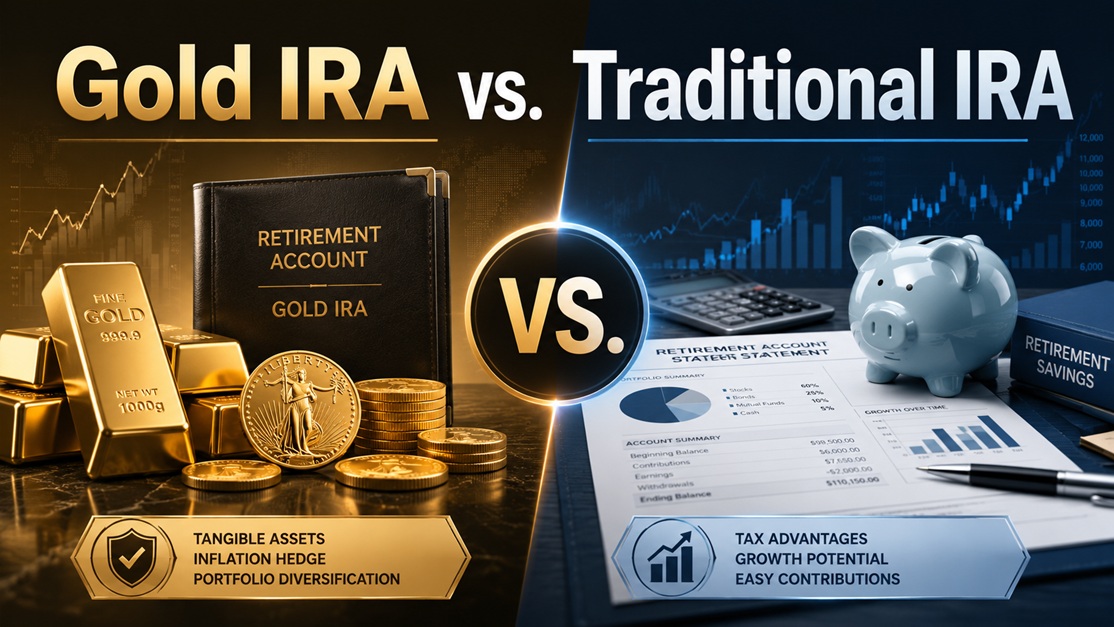
Search "gold IRA vs traditional IRA" and most results treat the two as opposite tax categories, pre-tax on one side, alternative assets on the other. That framing is wrong.
A gold IRA is still a Traditional IRA or a Roth IRA under the tax code. The label only says when you pay tax. It says nothing about what you're allowed to hold. This guide separates those two questions so you can compare what actually differs.
Gold IRA vs. Traditional IRA at a Glance
A gold IRA and a conventional IRA share the same federal tax rules for contributions, deductions, and required withdrawals. They diverge on holdings, custody, and cost. Both carry the identical 2026 contribution limit, $7,500 under age 50 and $8,600 at 50 and older, so that number never changes based on what you buy. Required withdrawals start at 73 for both accounts too. A gold IRA is self-directed and holds IRS-eligible physical bullion at an approved depository, while a conventional IRA instead holds securities at a brokerage. The table below lines up the differences.
| Factor |
Gold IRA (Self-Directed) |
Traditional / Conventional IRA (Brokerage) |
| What it holds |
IRS-eligible physical gold, silver, platinum, or palladium bullion and coins |
Stocks, bonds, mutual funds, exchange traded funds |
| Tax status options |
Can be set up as Traditional (pre-tax) or Roth (post-tax) |
Can be set up as Traditional (pre-tax) or Roth (post-tax) |
| Custody |
Self-directed custodian plus an IRS-approved depository |
Brokerage acts as custodian directly |
| 2026 contribution limit |
$7,500 under age 50, $8,600 age 50 and up |
$7,500 under age 50, $8,600 age 50 and up |
| RMD age |
73, then 75 |
73, then 75 |
| Typical costs |
Custodian fee, storage fee, and dealer spread on the metal |
Often free or low cost, sometimes a fund expense ratio |
| Risk profile |
No issuer or counterparty risk, no yield, price can be flat for years |
Market and issuer risk, potential for dividends, interest, and growth |
Request a Free Guide
Wait, Isn't a Gold IRA Also a Traditional IRA?
Yes, and that's exactly where most explanations lose people. "Traditional IRA" describes a tax status, pre-tax contributions and ordinary income tax on withdrawal, and a gold IRA can be built on that same status, or on a Roth status instead. What people usually mean by "gold IRA vs traditional IRA" is narrower, physical metal in a self-directed account versus paper assets at a standard brokerage.
Think of it as two separate questions, tax status and holdings. Tax status means Traditional or Roth, pre-tax or post-tax. Holdings means securities or IRS-eligible bullion. A gold IRA answers the tax-status question the same way any IRA does, using the identical $7,500 base limit set for 2026. It answers the holdings question differently, since it's self-directed rather than tied to a standard brokerage menu.
Under
Internal Revenue Code Section 408(m)(3), specific gold, silver, platinum, and palladium bullion and coins are carved out of the general collectibles ban. That carve-out has applied since 2022, and no special gold-only tax category exists. It says nothing about Traditional versus Roth status. That's the mix-up this guide untangles.
What Actually Sits Inside Each Account?
A conventional IRA holds securities, stocks, bonds, mutual funds, and exchange traded funds, tracked through a brokerage. A gold IRA holds physical bullion instead, and the IRS only allows specific products into that basket.
The fineness standards are strict, gold at 99.5% purity, silver at 99.9%, and platinum or palladium at 99.95%. One well-known coin breaks that rule on paper. The American Gold Eagle qualifies for IRA use even though its actual purity is only 91.67%, because Congress separately named it eligible.
| What's Inside |
Gold IRA |
Traditional / Conventional IRA |
| Core holdings |
Gold, silver, platinum, palladium bullion and coins |
Stocks, bonds, mutual funds, ETFs |
| Eligibility rule |
Must meet IRC 408(m)(3) fineness or a named coin exception |
No fineness test, standard securities regulation applies |
| Named exception |
American Gold Eagle (91.67% purity) |
Not applicable |
| Selection breadth |
Narrow, dealer-specific catalog |
Broad, thousands of securities available |
Augusta Precious Metals, the dealer this site covers, sells IRS-eligible gold and silver bullion for its self-directed IRA program. Read
Augusta's own gold IRA guide for a full walkthrough.
Request a Free Guide
Who Holds Your Money, and Where?
A brokerage holds your conventional IRA directly, executes trades, and sends the year-end tax forms, no extra layer involved. A gold IRA works differently by law. The bullion must sit with a separate custodian and an approved depository, not in your hands and not at the dealer who sold it.
That requirement comes from the statute itself. Section 408(m)(3) requires the bullion stay in the physical possession of a trustee, not the account owner. A parallel rule, Section 408(a), requires that any IRA, stock-based or gold-based, be run by a bank or an IRS-approved nonbank trustee. Neither lets you personally hold the assets and keep the tax benefit.
The Tax Court tested this directly. In McNulty v. Commissioner, decided in 2021, the court ruled that an IRA owner's physical possession of American Eagle coins in a personal safe counted as a taxable distribution, even though the coins were IRA-eligible. Home storage doesn't work, Traditional or Roth. A conventional brokerage IRA never raises this issue, since the securities never leave the brokerage's custody.
Doesn't it seem like custody should be the boring part of this comparison? It's actually where most of the cost and complexity lives.
How Are the Two Taxed?
Here's what surprises people most. Inside an IRA, a gold IRA and a conventional IRA are taxed the same way. A Traditional account of either type owes ordinary income tax on withdrawal. A Roth account of either type pays no tax on qualified withdrawals, and the asset inside doesn't change either rule.
That answer runs against something true about gold held OUTSIDE a retirement account. Under Internal Revenue Code Section 1(h), long-term gains on collectibles in a taxable account, including physical gold and silver, are taxed at a maximum 28% federal rate, well above the 20% top rate on most long-term securities gains. That 28% rate is a taxable-account rule. It has no bearing on what happens inside an IRA.
| Tax Question |
Gold IRA |
Traditional / Conventional IRA |
| Tax status options |
Traditional or Roth |
Traditional or Roth |
| Traditional withdrawal tax |
Ordinary income tax |
Ordinary income tax |
| Qualified Roth withdrawal |
Tax-free |
Tax-free |
| 28% collectibles rate applies inside the IRA |
No |
Not applicable, no collectibles held |
| 28% collectibles rate applies outside an IRA |
Yes, on physical metal in a taxable account |
No, standard capital gains rates apply |
See the site's
gold IRA tax benefits explainer for more on how this plays out inside Augusta's own program. One wrinkle only affects the gold side. A collectible bought outside the bullion exception counts as a deemed distribution the year it happens, taxed as ordinary income with a possible 10% penalty under age 59 and a half. A conventional account never faces this risk.
Request a Free Guide
What Happens at Retirement? Contribution and RMD Rules Compared
Every number here is identical across both account types. For 2026, the
Internal Revenue Service set the IRA limit at $7,500, up from $7,000 in 2025, with a $1,100 catch-up at 50 and older, for a total of $8,600. RMD rules match too, since the IRS regulates tax status, not what's parked inside the account.
Income phase-outs follow the same pattern. Single filers covered by a workplace plan phase out of the Traditional deduction between $81,000 and $91,000, and joint filers phase out between $129,000 and $149,000 when the contributing spouse is covered, or $242,000 to $252,000 when only the other spouse is covered. Roth eligibility phases out between $153,000 and $168,000 for single filers, and $242,000 to $252,000 for joint filers.
Required distributions run on the same calendar too. The
SECURE 2.0 Act set the RMD age at 73 for anyone turning 72 after 2022, moving to 75 after 2032. The same law cut the missed-RMD penalty from 50% to 25%, or 10% if corrected within two years. According to the IRS Uniform Lifetime Table, the divisor starts at 26.5 at age 73 and shrinks each year after, and account holders apply that same table whether the balance sits in stocks or bullion.
| Rule |
Gold IRA |
Traditional / Conventional IRA |
| 2026 contribution limit |
$7,500 (under 50), $8,600 (50+) |
$7,500 (under 50), $8,600 (50+) |
| Traditional deduction phase-out (single) |
$81,000 to $91,000 |
$81,000 to $91,000 |
| Roth phase-out (single) |
$153,000 to $168,000 |
$153,000 to $168,000 |
| RMD age |
73, then 75 |
73, then 75 |
| Missed RMD penalty |
25% (10% if corrected) |
25% (10% if corrected) |
The
contribution limits page breaks these figures down further if you want the full picture before funding an account.
Request a Free Guide
What Will Each Option Cost You?
A conventional brokerage IRA is often free or low cost to run, with no annual account fee at many major firms. The main cost you'll actually notice there is a fund's own expense ratio. A gold IRA carries a different cost structure entirely, one built around physical custody rather than trading volume.
Three layers stack up on the gold IRA side. A self-directed custodian charges an annual fee, and a depository charges its own annual storage fee. On top of both sits the dealer's buy-sell spread, the cost new buyers most often underestimate. The Commodity Futures Trading Commission's own advisory puts standard bullion premiums at roughly 5% to 10% over spot, while numismatic or collector coins can carry premiums of 40% to 200% over spot. That gap alone can make two same-size gold IRAs worth very different amounts in real metal. Augusta Precious Metals states in its own
FAQ that its prices and buy-back prices are determined and controlled by Augusta rather than posted live online, a pattern fairly typical across the industry.
| Cost Layer |
Gold IRA |
Traditional / Conventional IRA |
| Account fee |
Self-directed custodian fee, charged annually |
Often none at major brokerages |
| Storage or custody cost |
Depository storage fee, charged annually |
Included in standard brokerage custody |
| Hidden cost to watch |
Dealer spread, roughly 5% to 10% on bullion, 40% to 200% on numismatic coins |
Fund expense ratio, if applicable |
| Where the cost is disclosed |
Often by phone with the dealer, not always published live |
Published rate schedules and fund prospectuses |
Why does the spread matter more than sticker fees? It scales with what you buy, not a flat amount, and it's the easiest cost to miss when comparing published fee sheets.
Which Fits Your Retirement Plan?
Neither account is the objectively better choice. The right one depends on what you already own and the gap you're trying to close. Remember, both share the same $7,500 2026 contribution limit. Both also share the same age-73 RMD start. A gold IRA and a conventional IRA can even sit side by side in the same retirement plan, since nothing forces an either-or choice between them.
Choose a gold IRA if:
- Your savings sit mostly in stocks and bonds and you want a position with no issuer or counterparty risk
- You're comfortable paying custodian and storage fees for a physical, tangible asset
- You want a hedge that has historically moved somewhat independently of stocks, knowing it may sit flat for long stretches
Choose a conventional IRA if:
- You want the lowest-cost path to a diversified retirement account
- You value buying and selling instantly, with no dealer, custodian, or depository in the loop
- Growth, dividends, and interest matter more to you than an inflation hedge with no yield
Read our full
Augusta Precious Metals review for a closer look at one self-directed gold IRA provider's process, fees, and customer experience.
Request a Free Guide
Frequently Asked Questions
Is a Gold IRA a Type of Traditional IRA, or Something Separate?
A gold IRA isn't a separate tax category. It's typically set up as either a Traditional IRA or a Roth IRA, the same two statuses available to any conventional account. What makes it a "gold IRA" is that it's self-directed and holds IRS-eligible physical bullion under Internal Revenue Code Section 408(m)(3) instead of stocks, bonds, or funds. Contribution, deduction, and withdrawal rules follow the Traditional or Roth label, not the word "gold."
Does a Gold IRA Have a Different Contribution Limit Than a Traditional IRA?
No. The 2026 contribution limit is $7,500 under 50 and $8,600 at 50 and older, and it applies the same way whether the account holds securities or IRS-eligible physical metal. The IRS sets limits based on tax status, not what's inside the account, so both share one identical number each year.
Do I Pay the 28 Percent Collectibles Tax Rate if I Hold Gold in an IRA?
No. The 28% collectibles rate applies to physical gold held in a regular taxable account, not inside any IRA. Inside a Traditional IRA, withdrawals are taxed as ordinary income regardless of the underlying asset. Inside a Roth IRA, qualified withdrawals are tax-free. The 28% rate only shows up if you buy gold outside a retirement account entirely.
Can I Store My Gold IRA Metals at Home?
No. IRA-eligible bullion has to stay with an approved custodian and depository, not in your home safe. The Tax Court confirmed this in McNulty v. Commissioner, ruling that personal possession of IRA-owned coins triggered a taxable distribution. A conventional IRA never faces this issue, since its securities never leave brokerage custody.
Which Costs More to Maintain, a Gold IRA or a Conventional IRA?
A gold IRA usually costs more. It layers a custodian fee, a storage fee, and a dealer spread that can run from roughly 5% on standard bullion to well over 40% on numismatic coins. A conventional IRA is often free or carries only a fund's expense ratio, since physical custody isn't part of the equation.
Risk Warning: Precious metals investments carry risk, including the possible loss of principal. Gold and silver prices can fluctuate based on macroeconomic conditions, currency movements, and market sentiment. Securities held in a conventional IRA carry market and issuer risk and can lose value. Past performance is not a guarantee of future results. IRS rules governing self-directed IRAs and precious metals investments are complex and subject to change. The information here reflects rules as of the publication date and may not reflect recent regulatory updates. Always consult your own licensed legal, financial, and tax professionals before opening or funding either type of IRA.
About the Editorial Team
Augusta Precious Metals Reviews is the editorial site covering Augusta Precious Metals. We publish articles about Augusta's products, leadership, fees, customer experience, and gold IRA process under an editorial team byline. This piece compares account types, not companies, and cites named third-party authorities including the Internal Revenue Service, the Internal Revenue Code, the Tax Court, and the Commodity Futures Trading Commission. We do not publish urgent, scarcity-driven, or high-pressure content, and we close every educational article with a soft reminder to speak with your own legal, financial, and tax professionals before investing.
Disclosure: This site has a partnership with Augusta Precious Metals and may earn a commission from accounts opened through the contact methods here, per Federal Trade Commission affiliate-disclosure rules under 16 CFR Part 255. This comparison covers account structure and tax rules, not a recommendation to buy or sell any asset.
Once gold makes sense for you, see how to choose a gold IRA company.
Disclaimer: This article is for informational purposes only and does not constitute financial, tax, or legal advice. Consult a qualified professional before making investment decisions.