TL;DR: A gold ETF like GLD carries roughly a 0.40% annual expense ratio and sells in seconds on an exchange. Physical gold costs more since storage and dealer spread stack on top of custodian fees, but it gives direct ownership with no fund sponsor standing in between. Inside an IRA, neither one pays the 28% collectibles tax rate that applies outside an IRA, so the real choice comes down to control versus cost.
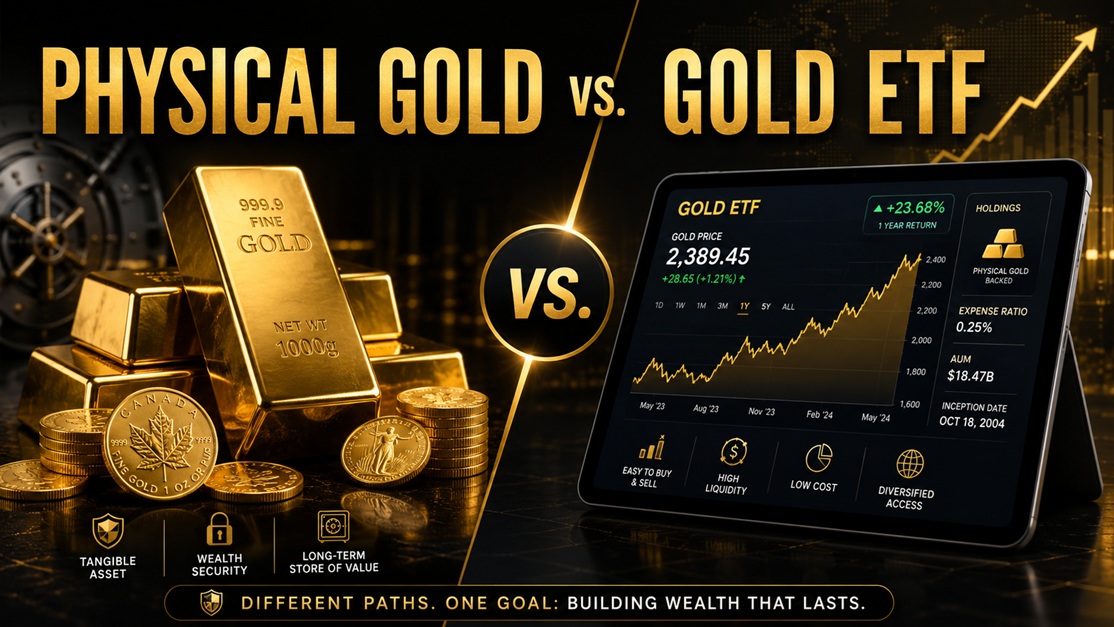
Physical Gold vs. Gold ETF in an IRA at a Glance
Here's the short version before the details. Physical gold means you own actual coins or bars sitting in a depository vault under your account's name. A gold ETF means you own shares of a fund that itself owns the bullion. The table below lines up custody, cost, tax, liquidity, and risk side by side.
| Factor |
Physical Gold in an IRA |
Gold ETF in an IRA |
| Custody |
Held by a depository under a qualified trustee |
Held by the fund, you hold shares in a brokerage IRA |
| Annual cost |
Custodian and storage fees plus a dealer spread |
A single expense ratio, 0.10% to 0.40% among major funds |
| Tax outside an IRA |
28% maximum collectibles rate on long-term gains |
Same 28% maximum collectibles rate on long-term gains |
| Tax inside an IRA |
Ordinary income (Traditional) or tax-free (qualified Roth) |
Ordinary income (Traditional) or tax-free (qualified Roth) |
| Liquidity |
Dealer buyback, subject to a spread |
Intraday exchange trade at the quoted price |
| Counterparty layers |
Depository and its insurer |
Fund sponsor and fund custodian |
| What Augusta offers |
Physical bullion and coins |
Not offered |
Request a Free Guide
How Does Custody Work for Physical Gold vs. a Gold ETF?
Custody is the clearest structural difference between the two. Physical gold inside an IRA has to sit with a qualified trustee, a depository, and you can never take it home while the account keeps its tax-advantaged status. A gold ETF is a security. You hold shares, and the fund itself owns the vaulted bullion.
That custody rule traces to
Internal Revenue Code Section 408(m)(3)(B), which requires IRA-eligible bullion to sit in the physical possession of a trustee, not the account owner. The Tax Court applied that rule hard in McNulty v. Commissioner, a 2021 case where an IRA owner who kept American Eagle coins in a home safe owed tax and penalties on the coins' full value as a deemed distribution. A gold ETF sidesteps the question entirely, since an ETF investor never takes possession of any metal. You hold a security, not a commodity, and the fund's custodian handles the vaulting.
| Custody Question |
Physical Gold |
Gold ETF |
| Who holds the asset |
A depository under an IRS-approved trustee |
The fund's custodian bank |
| Can you take possession |
No, not while the IRA stays tax-advantaged |
No, you hold shares, not metal |
| Governing rule |
IRC 408(m)(3) |
Securities regulation, not IRC 408(m) |
What happens if someone cuts corners anyway? The
IRS treats an improperly possessed collectible as an immediate deemed distribution, taxed as ordinary income on Form 1099-R, plus a possible 10% penalty under IRC 72(t) if the owner is under 59 and a half. That's a real tax bill, not a theoretical risk.
What Does Each Option Actually Cost?
Cost is where the gap between these two options gets concrete. Augusta's published fee stack for physical metal runs $275 in year one and $225 every year after, covering setup, custodian, and non-segregated storage, before the dealer spread on the metal itself. A gold ETF strips all of that down to one number, the expense ratio.
| Cost Item |
Physical Gold (Augusta) |
Gold ETF |
| One-time setup |
$50 |
None |
| Annual custodian fee |
$125 |
Built into the expense ratio |
| Annual storage fee |
$100, non-segregated |
Built into the expense ratio |
| Dealer spread |
Not published, disclosed by phone |
Not applicable |
| Expense ratio |
Not applicable |
GLD 0.40%, IAU 0.25%, GLDM 0.10% |
| Year-one total |
$275 |
Expense ratio only, no setup cost |
Run the math on a $50,000 account and the physical side costs roughly 0.45% a year in flat fees alone, before the spread even enters the picture. A gold ETF like GLDM costs a flat 0.10% no matter the balance. iShares Gold Trust runs higher at 0.25%, and SPDR Gold Shares runs 0.40%, according to
State Street's own fund fact sheet. That gap compounds in an investor's favor over a long hold. Does a cheaper wrapper always win on paper? Yes, on cost alone. What an investor gives up for that lower cost is the metal itself, a claim on a fund rather than a bar or coin with their account's name on it.
Augusta does not publish a live spot-linked price list or a fixed spread percentage. Pricing, including the buyback price, gets disclosed by phone, and Augusta states plainly that it determines and controls its own prices and buy-back prices, a gap worth asking about directly before funding an account.
Request a Free Guide
How Are Physical Gold and Gold ETFs Taxed Inside vs. Outside an IRA?
Tax treatment is where the two options converge, and that tends to surprise people who assume an ETF gets friendlier treatment by default. Outside an IRA, long-term gains on physical gold and on a gold ETF like GLD or IAU both get taxed at the same 28% maximum collectibles rate under
Internal Revenue Code Section 1(h), well above the 0%, 15%, or 20% rate that applies to most stocks. Inside an IRA, that 28% rate disappears for both assets.
| Setting |
Physical Gold |
Gold ETF (GLD, IAU) |
| Outside an IRA, long-term gain |
28% maximum collectibles rate |
28% maximum collectibles rate |
| Inside a Traditional IRA |
Ordinary income on distribution |
Ordinary income on distribution |
| Inside a Roth IRA, qualified distribution |
Tax-free |
Tax-free |
Here's the part that trips people up. A gold ETF gets taxed like a collectible outside an IRA because the fund itself holds physical bullion, and the tax code looks through the fund structure to the underlying asset. That's why GLD and IAU shares don't get the friendlier long-term stock rate in a taxable brokerage account. Move either asset inside an IRA and that distinction stops mattering. A Traditional IRA taxes the whole distribution as ordinary income, at whatever bracket the account holder is in the year the money comes out, regardless of whether the gain came from a coin, a bar, or a fund. A qualified Roth IRA distribution is tax-free, again regardless of the underlying asset. The 28% collectibles rate never enters the calculation inside either account type.
So why hold gold in an IRA at all, if the outside-IRA tax code treats gold worse than stocks? Because the IRA wrapper erases that 28% collectibles penalty for either asset, turning an expensive tax category into an ordinary retirement-account distribution. See our guide to
Augusta gold IRA tax benefits for the full Traditional and Roth breakdown.
Risk Warning: IRS rules governing self-directed IRAs and precious-metals investments are complex and subject to change. The details here reflect rules as of the publication date and may not capture the most recent regulatory updates. Consult a tax professional or your IRA custodian for current guidance before making a decision based on tax treatment.
Request a Free Guide
Which Is More Liquid, Physical Gold or a Gold ETF?
Liquidity favors the ETF by a wide margin, and it's worth being upfront about that. A gold ETF trades on a stock exchange all day, so an investor can sell shares in seconds at the quoted price. Physical gold in an IRA goes through a dealer buyback instead, on the dealer's schedule and the dealer's spread, not an open market quote.
| Liquidity Factor |
Physical Gold |
Gold ETF |
| Where you sell |
Back to a dealer |
On a stock exchange |
| Speed |
Days, depending on the dealer's process |
Seconds, during market hours |
| Price you get |
The dealer's buyback bid, below its ask |
The live market price |
| Who sets the price |
The dealer |
The open market |
Augusta states plainly that its prices and buy-back prices are determined and controlled by Augusta, standard for a dealer-driven market. That spread, the gap between what a dealer pays to buy metal back and what it charges a new buyer, is the real cost of turning physical metal into cash quickly. A gold ETF investor never faces that gap.
Does faster always mean better? Not for every saver. Some IRA holders want the friction. A dealer buyback process doubles as a forced pause before liquidating a long-term retirement position, a feature rather than a bug for someone prone to reacting to short-term price swings.
Request a Free Guide
What Counterparty and Structural Risk Does Each Option Carry?
Every version of gold ownership depends on somebody else doing their job correctly. A gold ETF adds two layers between an investor and the metal, the fund sponsor that runs the trust and the fund's custodian bank that physically holds the bullion. Physical gold in an IRA depends instead on the depository that vaults it and the insurance behind that vault.
| Risk Layer |
Physical Gold |
Gold ETF |
| Who holds the asset |
A depository, Augusta's primary partner is the Delaware Depository |
The fund's custodian bank |
| Insurance |
$1 billion all-risk coverage through Lloyd's of London at the Delaware Depository |
Coverage varies by fund, disclosed in the fund's own filings |
| Structural layers |
Trustee and depository |
Fund sponsor and fund custodian |
| What Augusta offers |
Physical bullion and coins only |
Not offered |
Augusta Precious Metals sells physical gold and silver bullion and coins for IRAs. It does not offer platinum, palladium, mining stocks, exchange-traded funds, paper gold, or a home-storage structure of any kind. If a gold ETF is the better fit for a given plan, that's a conversation for a brokerage or a fund provider, not a physical bullion dealer.
Which layer would an investor rather trust, a fund manager's paperwork or a depository's insurance policy? There's no universally correct answer. It comes down to which kind of counterparty risk feels more manageable to the person holding the account.
Which Should You Choose?
Here's the honest answer, without hedging. If direct ownership and no fund-sponsor layer matter more than cost, physical gold in an IRA is the better fit, and the extra $225 to $275 a year plus the dealer spread is the price of that control. If cost and liquidity matter more, a gold ETF wins on both, though it means holding a security instead of the metal itself.
Choose physical gold in an IRA if:
- You want a depository-held bar or coin with your account's name on it, not a claim on a fund
- You're comfortable paying custodian and storage fees plus a dealer spread for direct ownership
- You plan to hold long enough that ownership structure matters more than the annual fee gap
- You'd rather work with a dealer that handles the rollover, custodian, and depository relationship for you
Choose a gold ETF if:
- Minimizing annual cost is the priority, since GLDM's 0.10% expense ratio undercuts physical storage and custodian fees
- You want to buy or sell a position in seconds during market hours instead of waiting on a dealer buyback
- You're comfortable with a fund-sponsor and fund-custodian structure instead of a depository holding metal in your name
- A bullion dealer isn't the right starting point, since dealers like Augusta don't sell ETFs or paper gold
Either path stays inside the same IRA tax rules once the money sits in the account. The real decision is what kind of ownership you want to hold, not which option the tax code favors, since inside an IRA it favors neither. See our full
Augusta Precious Metals review for how the account-opening process and fee stack work in practice.
Risk Warning: Investing involves risk, including the possible loss of principal, and precious metals prices can be volatile based on global economic conditions, currency moves, and supply and demand. Past performance is not a guarantee of future results. This article is for informational purposes only and is not financial, tax, or legal advice. Consult a licensed financial advisor, tax professional, or attorney before deciding how to hold gold in a retirement account.
Request a Free Guide
Frequently Asked Questions
Can I hold a gold ETF inside a self-directed IRA instead of physical metal?
Yes. A gold ETF is a security, so it sits inside a regular brokerage IRA the same way a stock or mutual fund does. An investor does not need a specialized precious-metals custodian or a depository relationship, since the fund itself handles custody of the underlying bullion. Physical gold requires a self-directed IRA with a qualified trustee and an approved depository under IRC 408(m)(3).
Does the 28 percent collectibles tax rate apply to a gold ETF held inside an IRA?
No. The 28% maximum collectibles rate under IRC 1(h) only applies to gains realized outside a tax-advantaged account. Inside an IRA, a Traditional account taxes the full distribution as ordinary income, and a qualified Roth distribution is tax-free, regardless of whether the asset was a gold ETF or physical bullion. The collectibles rate never enters the calculation once an asset sits inside an IRA.
Which costs less over time, physical gold or a gold ETF?
A gold ETF is almost always cheaper to carry. GLDM's expense ratio runs 0.10% a year, IAU runs 0.25%, and GLD runs 0.40%, all well under Augusta's $225 flat annual fee for storage and custodian services, before counting the dealer spread. The gap narrows on very large balances, since ETF costs scale with the position while flat physical fees do not, but on a typical account the ETF wins on cost.
Can I convert physical gold in an IRA into a gold ETF, or the reverse?
Converting means selling one asset and buying the other inside the account, not a direct swap. A custodian sells the metal through a dealer buyback at the dealer's bid price and uses the proceeds to buy ETF shares, or runs the process in reverse. Each direction carries a transaction cost.
Does Augusta Precious Metals sell gold ETFs?
No. Augusta Precious Metals sells IRS-eligible physical gold and silver bullion and coins for IRAs and does not offer exchange-traded funds, paper gold, platinum, palladium, or a home-storage IRA structure. An investor who decides an ETF fits their plan better would need a brokerage or a fund provider instead of a bullion dealer.
About the Author
This article was produced by the Augusta Precious Metals Reviews Editorial Team, citing primary IRS and Tax Court sources wherever the rules get technical. We are not affiliated with State Street, iShares, or any other exchange-traded fund provider named in this article. Always consult your own legal, financial, and tax professionals before deciding how to hold gold in a retirement account.
Disclosure: This site has a partnership relationship with Augusta Precious Metals and may earn a commission from accounts opened through the contact methods on this site, in line with Federal Trade Commission affiliate-disclosure rules under 16 CFR Part 255. Augusta sells physical bullion only and does not offer the exchange-traded funds discussed in this article.
Comparing providers as well as products? Our guide on evaluating a gold IRA company helps.
Disclaimer: This article is for informational purposes only and does not constitute financial, tax, or legal advice. Consult a qualified professional before making investment or tax decisions.