Augusta Gold IRA Minimum Investment: How Much Do You Need to Start?
TL;DR: Augusta Precious Metals requires a $50,000 minimum to open a gold IRA, the highest published minimum among major providers and the account-opening threshold this guide breaks down. That figure sits at the top of an industry range that runs roughly $5,000 to $50,000, and the realistic way most savers clear it is a rollover from an existing 401(k), IRA, or TSP account, since a transfer isn't capped by the annual IRA contribution limit the way new deposits are. This guide covers what the minimum includes, how it compares industry-wide, who it suits, how to combine accounts to reach it, and whether the figure can change.
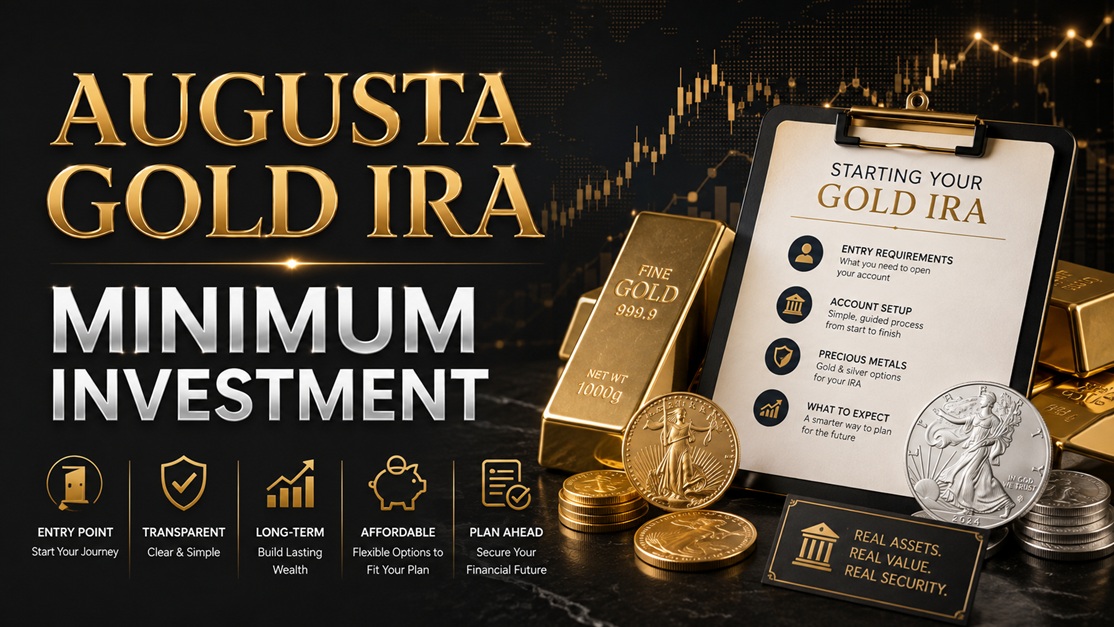
Every saver considering a gold IRA with Augusta Precious Metals runs into the same number early in the process. A $50,000 account minimum, the highest published minimum among major gold IRA providers according to Consumer Affairs, shapes who the account fits and how a saver funds it. That threshold is also why most Augusta accounts open through a rollover of an existing retirement balance rather than a fresh set of payroll contributions. This page breaks down what the minimum actually covers, how it compares industry-wide, why a rollover is the realistic path to it, who it suits, and what to do if a single account falls short.
Augusta Precious Metals sets its gold IRA minimum investment at $50,000, the amount a saver needs before opening a self-directed precious-metals account. Consumer Affairs documents that this figure sits at the top of the industry, describing it directly. "Augusta has a $50,000 minimum for orders, so you'll need at least that much to start investing," the site states in its Augusta profile.
The number covers the full account rather than a per-purchase floor, so a saver funds the account once and then selects gold and silver up to that starting balance. Nothing about the $50,000 figure changes based on whether the metal chosen is a coin, a bar, or a mix of both. Augusta pairs the minimum with a dedicated agent who walks through the figure before any paperwork begins, which keeps the number from arriving as a surprise midway through onboarding.
Why does Augusta set the bar this high rather than closer to a typical $10,000 or $25,000 floor? The company's own positioning ties the number to its education-first, dedicated-agent model, a slower onboarding built around a one-on-one conversation rather than a self-service signup form. A saver who clears the $50,000 threshold gets the same dedicated agent through funding, metal selection, and storage confirmation, not just the initial call.
Minimum investments across major gold IRA providers span roughly $5,000 to $50,000, according to Money, which places Augusta squarely at the ceiling of that range rather than in the middle of the pack. Money's own coverage frames the figure as a genuine downside worth weighing, noting that the required minimum investment amount is one real drawback of opening an account with the company.
That top-of-range position pairs with Augusta's dedicated-agent, education-first onboarding model, the same model Money credits when ranking Augusta among its top gold IRA picks. A saver comparing providers on minimum alone will find a wide field below Augusta, with some competitors opening accounts for a tenth of the amount.
The gap between the bottom and the top of that range can matter more than it looks on paper, especially for a saver weighing a smaller rollover against a larger one. Augusta's own framing treats the higher bar as the tradeoff for a slower, more thorough onboarding rather than a quick account-opening process, and the company does not publish a lower tier for smaller balances.
Ranking every major provider by minimum alone would put Augusta at one end of the list and a handful of smaller-account specialists at the other. A saver who values a lower barrier to entry over a dedicated agent might reasonably choose one of those smaller-minimum options instead. The tradeoff runs in both directions, and neither approach is objectively better for every saver.
A rollover from an existing 401(k), IRA, or TSP account is the fastest realistic path to Augusta's $50,000 threshold, because moving an existing balance sidesteps the yearly ceiling that governs brand-new contributions entirely. The Internal Revenue Service caps 2026 IRA contributions at $7,500 for savers under 50 and $8,600 for savers 50 and older, a pace that would take the better part of a decade to reach $50,000 through fresh deposits alone.
A trustee-to-trustee transfer of money already sitting in a workplace plan or an existing IRA carries no such ceiling, since the government treats a transfer of retirement savings a saver already holds as separate from a new contribution added this year. That distinction is the practical reason most Augusta gold IRA rollover accounts open funded by an existing balance rather than a fresh check.
Two savers with the same $7,500 annual contribution budget end up in very different positions if one also has a $60,000 401(k) sitting with a former employer. The saver with the existing balance can request a single transfer and clear the minimum in weeks. The saver relying only on new contributions needs years of maximum annual deposits to reach the same number. Confirming that a source account qualifies for a direct transfer is worth doing with a dedicated agent before starting any paperwork.
A direct trustee-to-trustee transfer also avoids the mandatory withholding that applies to some indirect rollovers, since the money moves custodian to custodian without ever landing in the saver's own bank account. That mechanical detail matters for reaching the minimum too, because a withheld amount is money that doesn't make it into the new gold IRA on the first pass. A saver rolling over a 401(k) balance close to the $50,000 line should ask whether the source plan handles the transfer as a direct or an indirect movement before assuming the full balance will arrive intact.
Augusta's $50,000 minimum fits a saver who already has a meaningful retirement balance sitting in a 401(k), traditional IRA, or similar account and wants to move a portion of it into physical gold and silver. It fits less well for an entry-level saver making a first retirement contribution from a paycheck, since that saver would need years of maximum annual deposits before reaching the threshold on new money alone.
Fortune and Money both note Augusta's $50,000 minimum as a customer-friendliness caveat worth knowing upfront, even while both outlets rank Augusta highly on service and education. Neither outlet treats the figure as disqualifying. Both simply flag it as the number a prospective customer should confirm fits their situation before starting the conversation.
A saver without a rollover-eligible balance is generally better served researching smaller-minimum options first and revisiting Augusta once an existing account has grown large enough to qualify. A saver with $80,000 or $100,000 already parked in a former employer's 401(k), by contrast, sits well past the threshold and can weigh Augusta's education-first approach against providers with a lower bar to entry.
A saver whose single retirement account falls short of $50,000 can often combine two or more accounts in one funding request instead of waiting for a single balance to grow. An old 401(k) from a previous employer paired with a traditional IRA opened years earlier, for example, can be transferred together once each account type has cleared its own individual transfer requirements.
Augusta's dedicated agent coordinates the paperwork on the receiving end, tracking each source account through its own custodian rather than treating the combined transfer as a single form. A $30,000 401(k) balance combined with a $25,000 traditional IRA, for instance, clears the $50,000 threshold with room to spare, even though neither account would qualify on its own.
The saver still needs every source account to independently qualify for its own transfer or rollover before the combined total counts toward the minimum. Telling the dedicated agent upfront that two or more accounts are being combined avoids a stalled funding request later, since mismatched paperwork between two custodians is the most common delay in a multi-account transfer.
A three-way combination works the same way as a two-way one. An old 401(k), a small traditional IRA from an earlier job, and a rollover-eligible pension balance can all feed the same Augusta account, provided each source clears its own custodian's transfer rules first. The paperwork simply takes longer to assemble with three moving pieces instead of one, so building in extra time for a multi-account funding request is worth planning for upfront.
Augusta sets its own account minimum, and the $50,000 figure has held steady for several years, but the company could revise it at any time since no external regulator dictates the number. A saver planning a rollover months in advance should treat $50,000 as the figure to plan around today, then confirm the current minimum directly with an agent close to the actual funding date.
Augusta Precious Metals publishes its account-opening process on its own site, though the minimum itself is best confirmed by phone rather than assumed from any third-party article, including this one. Treating a published figure as a starting point rather than a locked-in guarantee is the safer approach for any account minimum a private company sets on its own.
A saver who last checked the minimum a year or two ago should verify it again before finalizing a transfer amount. A $45,000 balance that once fell just short of $50,000 might already qualify, or the threshold might have moved in the other direction, and a quick call settles the question either way.
Frequently Asked Questions
Does Augusta Ever Waive the $50,000 Minimum?
Augusta Precious Metals has not published any waiver policy for its $50,000 account minimum, and the figure applies to every new precious-metals IRA the company opens. A saver close to the threshold should ask a dedicated agent directly whether a specific circumstance changes the requirement, since published third-party sources describe the minimum as fixed rather than negotiable. Treat the $50,000 figure as the number to plan around unless Augusta itself states otherwise in writing.
What Happens if Your Balance Falls Short of $50,000?
A saver whose available balance falls short of $50,000 generally needs to wait, grow the account further, or combine it with a second retirement account before Augusta will open a gold IRA. Some savers instead research providers with a lower published minimum while their own balance keeps growing through further contributions or investment returns. Revisiting Augusta once a rollover-eligible balance clears the threshold remains an option at any point, since the minimum is an account-opening requirement rather than a one-time application deadline.
Does the Minimum Apply to Every Metal Augusta Sells?
Yes, the $50,000 figure is an account-level minimum rather than a per-metal or per-product minimum, so it applies the same way whether a saver plans to hold gold coins, silver coins, gold bars, or a mix of both inside the account. Augusta does not publish a separate, lower minimum for silver-only or gold-only accounts. The threshold governs the account as a whole, and a saver decides how to split the funded balance across IRA-eligible coins and bars after clearing the minimum, not before.
How Does the Minimum Compare to Augusta's Annual Contribution Limits?
Augusta's $50,000 minimum is an account-opening threshold, while the IRS annual contribution limit is a separate yearly cap on new money added to any IRA, currently $7,500 for savers under 50 and $8,600 for savers 50 and older in 2026. The two figures serve different purposes and don't interact directly, since a rollover of an existing balance counts toward the $50,000 minimum without touching the annual contribution cap at all. A saver tracking both numbers should treat the minimum as a one-time funding target and the contribution limit as an ongoing yearly ceiling on fresh deposits.
Risk Warning: Precious metals investments carry risk, including the possible loss of principal. Gold and silver prices can fluctuate based on macroeconomic conditions, currency movements, and market sentiment. Past performance is not a guarantee of future results. A gold IRA is a long-term diversification tool, not a short-term trading vehicle. Always consult your own licensed legal, financial, and tax professionals before opening or funding a gold IRA.
About the Editorial Team
Augusta Precious Metals Reviews is the editorial site covering Augusta Precious Metals. We publish articles about Augusta's products, leadership, fees, customer experience, and gold IRA process under an editorial team byline. Our coverage cites named third-party authorities, including the Internal Revenue Service, Money, and Consumer Affairs, alongside Augusta's own published positioning. We do not publish urgent, scarcity-driven, or high-pressure content. We close every educational article with a soft reminder to speak with your own legal, financial, and tax professionals before investing.
Disclosure: This site has a partnership relationship with Augusta Precious Metals and may earn a commission from accounts opened through the contact methods on this site, in line with the Federal Trade Commission affiliate-disclosure rules under 16 CFR Part 255. Editorial coverage reflects Augusta's published positioning and the current rules governing self-directed precious-metals IRAs.
Disclaimer: This article is for informational purposes only and does not constitute financial, tax, or legal advice. Consult a qualified professional before making investment decisions.