Augusta Precious Metals Vault Security and Insurance: How Is Your Stored Metal Protected?
TL;DR: Augusta ships IRA gold and silver to the Delaware Depository, a Wilmington, Delaware facility built around Class 3 UL-rated vaults, the toughest commercial burglary rating sold, backed by round-the-clock security staff and layered detection systems. Stored metal carries $1 billion in all-risk insurance plus $100 million in contingent vault coverage through London underwriters, covering physical loss, mysterious disappearance, and employee theft, though war, terrorism, cyber-attack, and CBRN events are excluded. That $1 billion figure is a facility-wide aggregate cap shared across every customer at the depository, not a guarantee reserved for one account. This private policy is the only loss protection an IRA holder actually has, since neither FDIC nor SIPC protection extends to physical bullion at all. What follows breaks down the vault construction, the insurance terms, and what that FDIC and SIPC gap means in practice.
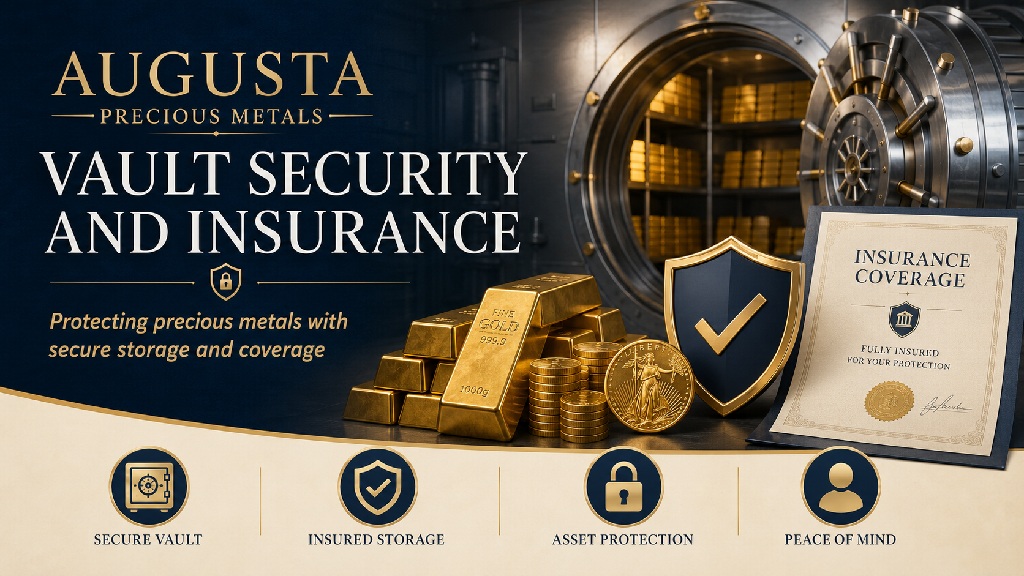
A saver moving retirement funds into physical gold or silver eventually asks the same question. Once the metal leaves the dealer, who is actually guarding it, and what happens if something goes wrong? For an Augusta account, the answer runs through the Delaware Depository, a facility with $1 billion in all-risk insurance layered on top of Class 3 vault construction. That headline sounds reassuring, and mostly it holds up. It also carries limits worth understanding before a saver assumes the coverage works like a bank account guarantee. Marketing pages tend to stop at the headline number. This page does not. The sections below cover what physically protects the metal, how the insurance program is structured, and why FDIC and SIPC protection, the two programs most savers already trust, do not reach a depository vault at all.
Physical security at the Delaware Depository starts with Class 3 UL-rated vaults, the highest commercial burglary rating a vault manufacturer sells. The UL 608 standard defines Class 3 as roughly a two hour resistance to hand tools, power tools, and cutting torches before an intruder could force entry, a concrete engineering spec rather than a marketing phrase.
That vault sits inside several additional layers. Reinforced walls, bullet-resistant windows, and multi-point locking bullet-resistant doors form the first barrier before anyone reaches the vault itself. Dedicated security staff monitor and record activity 24 hours a day, every day of the year, and the depository backs that staffing with motion, sound, and vibration detection running continuously. Dual controls and separation of duties mean no single employee moves bullion alone, background checks apply before anyone gets vault access, and loss-prevention metal detectors screen staff on the way out. Redundant power and communications keep every one of those systems running through an outage rather than going dark at the worst possible moment.
None of this is unusual for a facility built to custody exchange-grade bullion rather than ordinary valuables. A bank safe deposit box relies mostly on a single locked door and a shared vault room. This depository answers to something more demanding. It stores COMEX and NYMEX deliverable metal, which means answering to exchange auditors as well as its own insurers, so the layered approach is closer to a baseline requirement than an optional upgrade.
Why does that layering matter more than any single control? A vault rated for a two hour breach window still fails if the cameras go dark or the staff monitoring them are unvetted. No single layer does the job alone. A camera catches what a locked door misses, and a second staff member checking a colleague's work catches what a camera never will. The depository's own published security description treats these as one connected system rather than a checklist. Augusta does not design or run any of this directly. It ships purchased metal to a facility whose entire business is keeping bullion secure, an arrangement worth understanding alongside why home storage fails IRS rules in the first place, which explains why an IRA cannot use a personal safe as a substitute.
The Delaware Depository is a limited purpose trust company founded in 1999, chartered and examined by Delaware's state banking regulator rather than run as an ordinary retail bank. Its headquarters sits in Wilmington, Delaware, and Augusta also references a second IRS-approved vault in Boulder City, Nevada for IRA storage. City and state are the identifying detail here. Neither location's exact street address changes what actually protects the metal inside. A charter, an examiner, and a specific city are the details that actually matter for a saver deciding whether to trust the arrangement.
Customer bullion sits off the depository's own balance sheet, titled to the customer under the Uniform Commercial Code rather than as an asset the depository could claim as its own in a dispute or bankruptcy. That structure traces back to IRC 408(m), which carves out specific gold, silver, platinum, and palladium bullion from the general collectibles ban that otherwise applies to retirement accounts, provided a qualified trustee keeps physical possession. A companion provision, IRC 408(n), sets out the bank and nonbank trustee framework a facility has to qualify under before it can hold that bullion for an IRA at all.
Exchange-level approvals reinforce that tax-code eligibility. Delaware Depository is licensed by CME Group across the COMEX and NYMEX divisions to store gold, silver, platinum, and palladium bullion, and it carries a separate approval from ICE Futures US. Those sit alongside the IRS's own nonbank trustee approval process, which requires a facility to demonstrate fiduciary capacity, adequate net worth, and audited recordkeeping before it can custody IRA assets. As the depository's own FAQ page lays out, those exchange and IRS approvals sit on top of a facility that already meets Class 3 vault standards well before any account ever gets funded, so the paperwork approvals and the physical security work as one package rather than two separate stories. A dedicated agent handles how an Augusta gold IRA account actually gets opened and funded through the account-opening process, a separate topic from the storage facility covered here.
Delaware Depository maintains $1 billion in all-risk insurance for bullion held in its vaults, on top of $100 million in contingent vault coverage. The policy runs through London underwriters and covers all risks of physical loss or physical damage, including mysterious disappearance, unexplained loss and shortage, and employee dishonesty and theft. That is a wide coverage net compared to a typical property policy, and it explains why the figure shows up so often in marketing.
The same policy carries real exclusions. War, terrorism, cyber-attack, and radioactive, chemical, biological, and electromagnetic weapon events are excluded from the coverage, a standard carve-out for this type of vault policy rather than something unique to Augusta or its depository. Read that exclusion list carefully. It is not a loophole. Every commercial vault policy in this space carries some version of it, because insurers price war and cyber risk separately from ordinary theft and mishandling risk. A dedicated review from Money corroborates the headline figure independently, noting that once the depository receives a customer's precious metals, a $1 billion all-risk policy issued through London underwriters applies. Augusta repeats the same figure on its own silver IRA page, describing $1 billion in all-risk insurance backed by leading London underwriters. Delaware Depository's own BBB profile phrases the same coverage as Lloyd's of London, which is consistent language rather than a contradiction, since Lloyd's of London is the market London underwriters typically draw from. Three separate sources landing on the same figure is a good sign the number is real, not just a recycled marketing line.
No. FDIC coverage protects bank deposits up to $250,000 per depositor per ownership category, and SIPC coverage protects brokerage securities up to $500,000, including a $250,000 limit for cash held in the account. Neither program was built with physical bullion in mind, and neither one covers it.
Commodity futures contracts and physical precious metals sit outside both programs by statute, not by some gap in paperwork. The FDIC's $250,000 ceiling applies per depositor per bank, and SIPC's $500,000 ceiling applies per customer at a single brokerage, but neither number was ever built to include a bar of gold sitting in a vault. A saver who assumes a $1 billion insurance headline works the way FDIC deposit insurance works is comparing two entirely different protection systems. Both FDIC and SIPC are government-backed programs funded through participating institutions. The depository's coverage is a private commercial policy the facility purchases from London underwriters on its own initiative. Does that distinction actually change anything for an account holder? It does, because it means the private policy is the only loss protection standing behind stored IRA metal, with no government backstop sitting underneath it if that private coverage were ever exhausted or disputed.
Less than the headline number suggests on its own. The depository describes $1 billion in insurance for bullion held across its vaults as a whole, not as a promise attached to any single customer's account. That framing makes the $1 billion a facility-wide aggregate cap, shared by every customer's holdings at the depository, rather than a guarantee reserved for one saver's balance.
A saver with a modest position rarely needs to think past the headline figure. Someone holding a large balance gets more clarity by asking Augusta or the depository directly for an individual coverage sub-limit in writing, rather than assuming the $1 billion figure describes protection set aside specifically for their account. Getting that confirmation in writing costs nothing. It also closes the one real gap between the marketing headline and what a specific account actually carries. A saver who never asks the question simply never finds out where that gap sits.
This is not a reason to distrust the figure. A $1 billion aggregate policy is still a substantial backstop compared to leaving bullion in an unrated home safe with no coverage at all. It is simply a reason to read the number the way an insurer reads it, as a shared ceiling across the whole facility, rather than the way a marketing page presents it, as a single reassuring headline.
Frequently Asked Questions
Does the Delaware Depository Use Armed Guards?
Some review sites describe the depository as using armed guards, but that specific wording does not appear on the depository's own published pages. The language Delaware Depository actually uses is dedicated security staff monitoring and recording activity 24 hours a day, every day of the year. That is a real distinction, not a technicality. A saver who wants the exact staffing posture confirmed, armed or unarmed, should ask Augusta or the depository directly rather than relying on a review site's paraphrase of what the facility does.
Does the Insurance Pay Full Replacement Value for Lost Metal?
Some third-party sources describe the coverage as paying full replacement value, but the depository's own published FAQ describes all risks of physical loss without spelling out that exact valuation basis. This is a detail worth confirming directly rather than assuming, since the difference between a replacement-value payout and some other valuation method could matter a great deal in an actual claim. A claim scenario is exactly the wrong moment to discover the valuation formula for the first time. Ask Augusta or the depository for the specific valuation language in writing before treating full replacement value as settled fact.
Are Shipments to and from the Depository Insured Separately?
Yes. Shipments moving to or from the Delaware Depository by mail or express carrier carry their own coverage of up to $100,000 per package, a distinct policy from the $1 billion vault coverage that applies once metal is on site. Two separate policies, two separate moments. That separate shipping policy matters most during the initial purchase, when metal is in transit from Augusta's supplier to the depository, and again if a saver ever requests an in-kind distribution shipped to their own address.
What Should a Large-Balance Holder Ask About Coverage Above the Cap?
A saver with a large position should ask for an individual coverage sub-limit in writing, rather than relying on the $1 billion aggregate figure alone. Because that cap covers every customer's bullion at the facility at once, a written confirmation of how the depository or Augusta would handle a specific account's exposure gives a large-balance holder something concrete to point to instead of a marketing number that was never meant to describe one account's protection in isolation. The question costs nothing to ask and nothing to answer honestly, which makes it a reasonable one to raise before funding a large account rather than after.
Risk Warning: Precious metals investments carry risk, including the possible loss of principal. Gold and silver prices can fluctuate based on macroeconomic conditions, currency movements, and market sentiment. Past performance is not a guarantee of future results. Insurance and vault security reduce the risk of physical loss or theft, but they do not protect against price volatility in the underlying metal. IRS rules governing self-directed retirement accounts and depository requirements are complex and change with new legislation. Always consult your own licensed legal, financial, and tax professionals before opening or funding a gold IRA.
About the Editorial Team
Augusta Precious Metals Reviews is the editorial site covering Augusta Precious Metals. We publish articles about Augusta's products, leadership, fees, customer experience, and gold IRA process under an editorial team byline. Our coverage cites named third-party authorities, including the Internal Revenue Service and Money, alongside Augusta's own published positioning. We do not publish urgent, scarcity-driven, or high-pressure content, and every educational article closes with a soft reminder to speak with your own legal, financial, and tax professionals before investing.
Disclosure: This site has a partnership relationship with Augusta Precious Metals and may earn a commission from accounts opened through the contact methods on this site, in line with the Federal Trade Commission affiliate-disclosure rules under 16 CFR Part 255. Editorial coverage reflects Augusta's published positioning and the current rules governing self-directed precious-metals IRAs.
Disclaimer: This article is for informational purposes only and does not constitute financial, tax, or legal advice. Consult a qualified professional before making investment decisions.