Augusta vs. Priority Gold: Which Gold IRA Company Is Better for You?
TL;DR: Priority Gold's defining feature is at the exit, not the entrance. It offers three ways to sell metal back, an open-market sale, a consignment option with an 18% fee, and an immediate liquidation option, a spread none of the other Augusta comparisons on this site show at any competitor. Augusta counters with a published flat-fee schedule, a firm $50,000 minimum, and a required education session before you buy. Priority stocks all four major metals against Augusta's gold and silver, but its minimum, fees, and founding year shift by source. Both carry an A+ Better Business Bureau rating, though Priority shows more complaint volume. This weighs documented numbers against flexible ways to sell, not a clear winner against a clear loser.
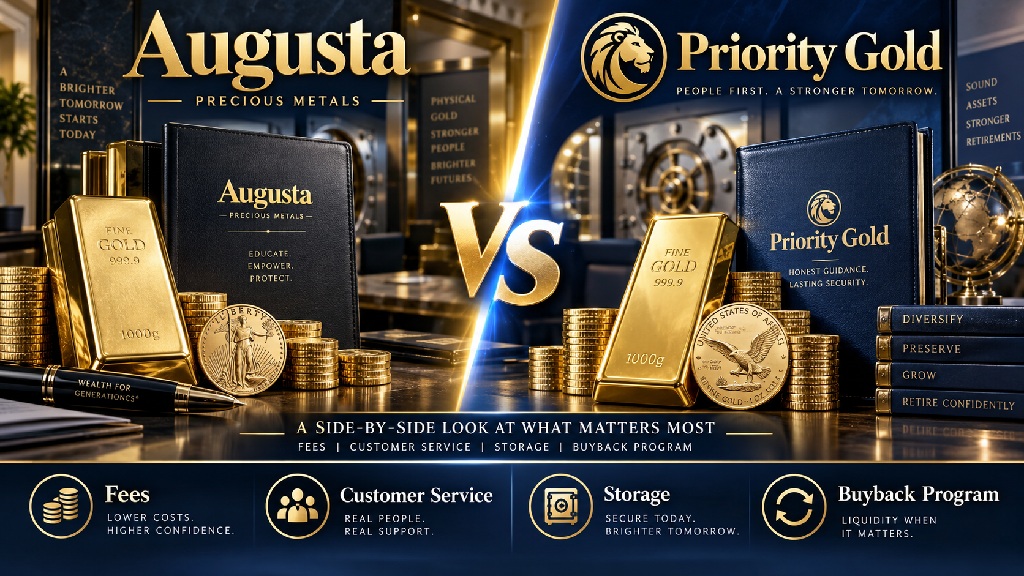
Most Augusta comparisons on this site turn on the minimum or the fee schedule. This one turns on something the others barely cover, what happens when you eventually want to sell. Priority Gold, a Dallas, Texas dealer, builds part of its pitch around exit flexibility, laying out three distinct ways to liquidate metal instead of the single buyback most dealers offer. Augusta takes the opposite approach, publishing its fees and its $50,000 minimum in writing and requiring a one-on-one education session before you buy. Priority, by contrast, leaves its minimum, fees, and founding year unsettled across the sources that cover it. This comparison spends its time on that trade-off rather than repeating ground already covered elsewhere on this site.
Augusta vs. Priority Gold at a Glance
The table below puts the two companies side by side. A few rows matter more than the rest, the minimum, the fees, the metals, and the buyback options, where this matchup actually differs. The rest lines up close to a typical Augusta comparison.
| Feature | Augusta Precious Metals | Priority Gold |
| Founded | 2012 | Reports vary between 2001 and 2015 (confirm directly) |
| Headquarters | Beverly Hills, California | Dallas, Texas |
| IRA account minimum | $50,000 | Reports vary, about $10,000 to $25,000 (confirm directly) |
| Setup and annual fees | $50 setup, $125 custodian, $100 storage, all published | Not published online (confirm by phone) |
| Metals offered | Gold and silver | Gold, silver, platinum, and palladium |
| Custodian | Equity Trust | Preferred Trust Company (Las Vegas) |
| Depository | Delaware Depository | Not disclosed in available materials |
| Buyback options | One dealer-set buyback | Open-market sale, consignment (18% fee), or immediate liquidation |
| Buying process | Mandatory education session | Not documented in comparable depth (confirm directly) |
| BBB rating | A+, accredited since 2015 | A+, accredited December 2023 |
| Complaint and legal record | None found in public records | No lawsuits found. About 36 BBB complaints over three years |
A Fixed Floor Against a Moving Target
Augusta's minimum isn't up for debate. It's $50,000, stated the same way everywhere the company publishes it, and that figure alone rules out a large share of rollovers. Priority Gold offers no such certainty. Depending on the source, its minimum ranges from roughly $10,000 to $25,000, and Priority's own materials don't settle on one published figure.
That gap changes the math for a mid-size rollover. At $15,000, the lower end of Priority's range puts an account within reach while Augusta's floor stays out of reach entirely. If the higher figure is the accurate one, that same $15,000 might not clear Priority's bar either, so confirm the real number by phone before assuming anything, rather than trusting a figure from any comparison site, including this one.
Why does Augusta hold to one public number while Priority's shifts by source? Augusta pairs its $50,000 floor with a dedicated agent and a required education session, and Fortune has called that minimum the main trade-off worth weighing before choosing the company. A lower, less consistent minimum tends to travel with a dealer competing on accessibility and flexible exits rather than a high entry bar. Neither model is dishonest, but only one lets you plan around a number you can verify in advance. We cover the reasoning behind Augusta's $50,000 minimum elsewhere on this site.
The Fee Schedule Only One of Them Publishes
Augusta's fee math fits on an index card. Priority's doesn't exist anywhere you can read it. That asymmetry, not the dollar amounts, is really the story here.
Augusta charges a $50 setup fee once, then bills $125 a year to Equity Trust as custodian and $100 a year for non-segregated storage, itemized on its own fee guide. That's $275 in year one and $225 every year after. Priority Gold does not publish a fee schedule online, so there's no dollar figure worth stating here as fact. Confirm the annual cost by phone before assuming it looks anything like Augusta's.
One fee does surface in Priority's own materials, though it isn't an annual charge. Its consignment buyback option carries an 18% fee taken out of the eventual sale proceeds, a real number worth knowing before you pick a way to sell, covered in the section below.
Neither company's numbers include the markup built into the metal itself, the spread between wholesale cost and what you pay. Both quote that only by phone, and on a large order it can dwarf a decade of flat fees. Ask each for the spread on the specific coin or bar you want before a setup or storage fee sways your decision.
Incentives: What Augusta Offers, and What Priority Doesn't Say
On top of its published numbers, Augusta dangles an entry-side incentive of its own, a fee-coverage promotion that can run as long as ten years on qualifying account sizes and wipes out the $225 yearly charge for however long it stays active. Priority Gold does not appear to publicize a comparable incentive in the materials available for this comparison, which isn't the same as confirming none exists. Dealers add and drop promotions on their own timelines, and a phone call is the only reliable way to find out what Priority currently offers a new account.
Treat any incentive at either company as a tiebreaker rather than a reason to choose. Thresholds and terms change, and the offer described today may not be the one on the table when you actually fund an account. Get current terms in writing before you count on either one.
Priority's Three Ways Out: Open Market, Consignment, or Immediate Sale
This is where Priority Gold stands apart from the other companies in this comparison series, including Augusta. Most dealers offer one buyback path, a single quote, take it or leave it. Priority lays out three.
The first is an open-market sale, where Priority helps you sell metal into the broader market rather than back to the company itself. The second is a consignment option, where Priority holds and markets the metal for you and takes an 18% fee out of the proceeds once it sells. The third is an immediate liquidation option, a faster path for a seller who wants cash now rather than the potentially better price a slower sale might bring.
Each path trades speed against cost differently. Immediate liquidation favors speed and likely a wider discount, though Priority doesn't publish an exact figure. Consignment chases a better price, with the fee coming out only once a sale closes, so you pay for market access rather than immediacy. The open-market option sits between the two. Ask Priority which option fits your situation, the timeline for each, and whether the 18% fee is the only added cost.
Augusta's buyback works differently. It offers to repurchase metal but discloses that it sets and controls its own buyback pricing, with no menu of options. Neither structure is better in the abstract. Three paths mean more choice about trading speed for price, but also more terms to confirm. One path is simpler precisely because there's only one. Whichever company holds your metal, get the buyback terms in writing before you need them.
The Buying Experience: Documented on One Side, Undocumented on the Other
Few parts of Augusta's business are as well documented as how it brings a new customer in the door. Before any account opens, Augusta requires a one-on-one web conference with Devlyn Steele, its Director of Education and a member of the business analytics program at Harvard Business School. The session exists to walk a prospective customer through how a self-directed precious-metals IRA is structured, who ends up holding the metal, and where the risk actually sits, all before a specific coin or bar enters the conversation.
Priority Gold's process isn't documented in that same depth in the materials available for this comparison. Whether it requires a comparable education step, moves at a faster self-service pace, or falls somewhere in between isn't settled by anything public enough to state here as fact, worth naming plainly rather than guessing at what a Dallas-based dealer's sales call looks like.
A required class before buying will read as reassuring to some and as friction to others, and that split is worth naming rather than glossing over. If the upfront structure sounds appealing, ask Augusta for a walkthrough before you commit. If you'd rather skip a required class altogether, put that same question to Priority directly rather than assuming either way. A company's openness about describing its own process tells you something useful no matter which one you end up choosing.
The Steps Behind Opening Either Account
Strip away the sales pitch and the mechanics behind both accounts run the same basic path. A self-directed IRA gets opened through a third-party custodian, funded by either a straight transfer or a rollover from an existing retirement account, and then it's a matter of choosing metals and having them shipped to an approved depository. At no point along that path does either company take physical custody of what you've bought.
Augusta pairs the same two names on every account it opens, Equity Trust as custodian and Delaware Depository for storage, and its own materials never deviate from that pairing. Priority Gold works with Preferred Trust Company, a Las Vegas-based custodian, though its materials say less about where metal is ultimately stored. If a disclosed storage location matters to your decision, ask Priority for that detail directly.
At either company, tax paperwork runs through the custodian, not the dealer, so it's the custodian who issues your forms and reports to the IRS no matter which sales team walked you through the purchase. The clock that matters most is the custodian's, not either dealer's sales projections. A plain transfer typically closes out within a week or two, though a rollover out of a workplace plan can stretch longer depending on how your plan administrator handles it. Confirm the current timeline with whichever company you choose, keeping in mind that what actually sets these two apart tends to show up later, at resale, more than in how the account gets opened.
Same Ratings, a Different Complaint Picture
Glance at the headline ratings and the two look evenly matched. Augusta carries an A+ Better Business Bureau grade, a 4.8 average on Trustpilot, and a comparable score over at Consumer Affairs. Priority Gold also holds an A+ Better Business Bureau rating, accredited since December 2023. It takes looking past the letter grade for a real difference to turn up.
Priority's BBB file lists about 36 complaints over the past three years, with roughly 16 filed in just the most recent twelve months. Augusta sits on the opposite end of that same three-year window, with a complaint record that's close to nonexistent. Volume is the operative word there, not wrongdoing, and the distinction matters because of what a BBB complaint count actually captures. Anyone who files a complaint gets counted, whatever the eventual outcome, so the tally alone says nothing about whether Priority handled a given case well.
Neither company turns up a lawsuit or regulatory action in public records as of this writing. Priority's complaint volume is a legitimate data point, not a disqualifying one, especially since a growing company tends to accumulate more complaints by serving more customers. Still, a meaningfully higher count than a close competitor's near-zero record is worth reading yourself rather than taking either company's marketing on faith.
Augusta's current placement in Money's rankings is Best for Educational Resources, an updated category from the Best Overall Gold IRA Company title the outlet gave Augusta every year from 2022 through 2025. Priority Gold does not appear in a named category on Money's current rankings, which reflects that list rather than a judgment on Priority.
Which Company Is the Better Fit?
Your situation, more than either company's overall quality, decides this one. Augusta gives you numbers you can read before you call, a stated minimum, a published fee schedule, and a documented process, in exchange for a higher bar and a required class first. Priority gives you a lower, more flexible entry point, four metals instead of two, and three ways to sell when the time comes, in exchange for figures you'll only get by phone. Neither pick is a mistake. Here's how it tends to break down.
Choose Augusta Precious Metals if:
- You want a fee schedule, minimum, and sales process you can read before calling anyone.
- Your rollover clears $50,000 without much question.
- You're comfortable with a required education session before funding an account.
- A near-zero public complaint history ranks high on your list.
Choose Priority Gold if:
- Your rollover is likely under $50,000 and you need Priority's lower reported minimum to qualify.
- You want exposure to platinum and palladium alongside gold and silver.
- Multiple ways to liquidate, including a faster immediate option, matter more than a single dealer-set buyback.
- You're comfortable confirming fees, minimum, and process by phone rather than online first.
Whichever way you lean, put the same direct questions to both companies before funding anything. What's the complete fee schedule in writing? What minimum applies today? What markup sits inside the coin or bar you're quoted, and what does each buyback option pay out after fees? A company that answers all three without hesitation is behaving the way a legitimate dealer should. Read the full Augusta Precious Metals review for a deeper look at its process, and see our Augusta vs. Goldco vs. American Hartford Gold comparison for a third option.
Frequently Asked Questions
Priority Gold is the more likely fit, though not a certain one. Reports place its minimum anywhere from about $10,000 to $25,000, so a $15,000 rollover may or may not clear its bar. Augusta's $50,000 minimum rules it out at that balance regardless. Call Priority directly and confirm its current minimum before assuming a $15,000 balance qualifies, since the published estimates don't agree closely enough to treat as settled.
Priority Gold doesn't explain the discrepancy in its own materials, so any specific reason would be speculation. What's verifiable is that sources report its founding year as either 2001 or 2015, and its minimum anywhere from about $10,000 to $25,000. Augusta, by contrast, states both the same way every time. Get a firm answer from Priority directly rather than from any comparison article, including this one.
The three options trade speed for price. An open-market sale routes metal into the broader market rather than back to Priority itself. A consignment sale has Priority hold and market the metal for you, with an 18% fee taken out once it sells. An immediate liquidation option pays out faster, likely at a wider discount, without waiting on a sale to close. Which pays the most depends on the metal, market conditions, and how quickly you need the money, so ask Priority for a specific quote under each option.
Not on its own. A BBB complaint count measures how many customers filed a complaint, not whether the company resolved it well. Priority's file shows about 36 complaints over three years against Augusta's close-to-zero record, a real difference in volume worth knowing. Neither company shows a lawsuit or regulatory action in public records. Read Priority's actual BBB file yourself rather than relying on a complaint count alone.
No. Augusta's lineup is limited to gold and silver, while Priority Gold offers all four IRA-eligible metals, gold, silver, platinum, and palladium. If diversifying across all four matters to you, Priority is the only one of the two that currently makes it possible. If gold and silver alone are enough, Augusta's narrower lineup reflects the two metals it has chosen to focus on rather than a limitation.
Risk Warning: Investing in precious metals carries real risk, up to and including loss of principal. Gold and silver prices move on macroeconomic conditions, currency shifts, and market sentiment, none of which is predictable in advance. Past performance offers no guarantee of what comes next. Treat a gold IRA as a long-term diversification tool rather than a vehicle for short-term trading. Before opening or funding a gold IRA with any company, always consult your own licensed legal, financial, and tax professionals.
About the Editorial Team
The Augusta Precious Metals Reviews Editorial Team runs this site as independent coverage of Augusta Precious Metals, publishing on its products, leadership, fee structure, customer experience, and gold IRA process under a shared team byline rather than individual reporter names. For this piece, Augusta gave its approval to discuss Priority Gold in neutral, factual terms, and we held ourselves to an independent bar throughout, drawing on named third-party sources, the Better Business Bureau, Trustpilot, Consumer Affairs, Money, and Fortune, plus the fee pages each company publishes on its own site. Urgency tactics, scarcity language, and high-pressure pitches don't appear in what we publish. Every educational piece closes the same way, with a gentle nudge to run the decision past your own legal, financial, and tax professionals before investing.
Disclosure: This site has a partnership relationship with Augusta Precious Metals and may earn a commission from accounts opened through the contact methods on this site, in line with the Federal Trade Commission affiliate-disclosure rules under 16 CFR Part 255. This comparison was written to be neutral and independent. Augusta authorized this article to name Priority Gold on factual, neutral terms only, and no sentence here was written to steer you toward Augusta over Priority Gold.
Disclaimer: This article is for informational purposes only and does not constitute financial, tax, or legal advice. Consult a qualified professional before making investment decisions.